#WTF is Latino at the 2013 Toronto International Film Festival?

The 288 features that make up the mega-sized and mega-watt Toronto International Film Festival have been announced.  It is awesome to see South America in the house and a substantial number of films from Mexico and Spain.  Sadly on the US Latino representation front we got next to nada.  Is it possible that it’s not since 2006 the festival has screened a US Latino film?   Bella by Alejandro Monteverde, about two people in NYC who fall in love, ended up winning the People’s Choice Award.  Randomly, in looking up the title to refresh my memory I came across this review by the late, great Roger Ebert who makes an amusing dig on Variety critic Robert Koehler about ‘being late’ in the course of reviewing the film.

Out of the 70 *countries the program represents, 26 of them are from Spain, Mexico (both which lead the pack with 7 films respectively), followed by Portugal, Brazil, Peru, Chile, Venezuela, Uruguay and Costa Rica.  Note this figure includes co-productions.

0 ,  “Ahem” that is,  Zero U.S. Latino filmmakers.  I have made an inquiry to the festival to confirm, if I hear different I will update.

Before the copied and pasted list of film descriptions and pics courtesy of TIFF – let me also note:

I’m so excited to see films play on this important world cinema stage that hail from Puerto Rico, Costa Rica, Peru and Uruguay, countries who have fledgling film industries but such unique narratives and exciting filmmaker voices to tell them.

Latin/Spanish language genre is hot.  Alex de La Iglesia is back with another pulse throbbing spine-tingling, action flick, Witching and BeWitching which he describes as a It’s a Mad Mad Mad Mad World.  I can’t wait to see this at Fantastic Fest.  Also making a return to Midnight Madness this year is Eli Roth and Chilean filmmaker Nicolas Lopez with The Green Inferno.   They previously teamed up on horrifying ‘real life’ scenario thriller, Aftershock.

A few Latino actors are sprinkled across English language films like Mexican Demian Bichir in Dom Hemingway by Richard Shepard, Colombiana Sofia Vergara in John Turturro’s Fading Gigolo and Dominicana Zoe Saldana in french hottie actor/director (Marion Cotillard’s man) Guillaume Canet’s Blood Ties.
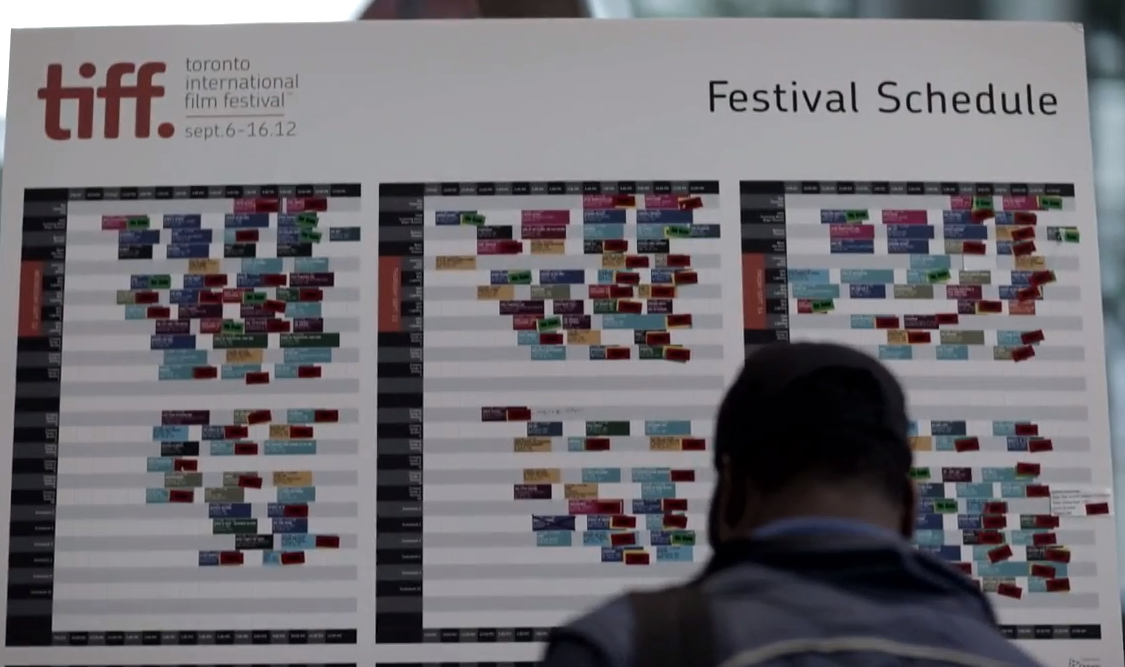
Screen Shot 2013-08-20 at 2.41.45 PMMy M.O. in this series is  to dig through festival films’ log lines and cast to find and highlight actors, stories and filmmakers that might bear some Latino sensibility ahead of the festival’s opening.  My overriding goal is to expand on what a Latino story might be, and by monitoring some of the big fests’ track records try to illuminate the context and obstacles that emerging Latino film artists smash up against.  Reading through the film descriptions of this year’s TIFF, I find some really rad sounding and innovative twists of classic storytelling, as well as interesting revisiting of American history.  Which is why I’m so troubled by the near total exclusion of Latinos in both the cast and filmmaker roles, especially given our hard to ignore populace.   There are two stories set in Texas and neither feature one Mexican American role.  (Parkland about the 48 hours after the JFK assassination, and Dallas Buyers Club in which Matthew McConaughy travels across the Mexican border for HIV drugs).  Then there are a handful of contemporary films that take place in an imagined New York/LA/Midwest and likewise I don’t see any US Latinos in the otherwise homogenized billed cast so its like we don’t register on any plane of representation.  Black films, filmmakers and cast are slowly but steadily gaining profile in these big festivals and in the mainstream media but US Latinos are sorely behind.    I know its not news-breaking but it is heart breaking and it does not cease to shock me to find such a lack of interest in discovering US Latino talent.  As far as I can tell there are not any narratives from the US Latino perspective in TIFF’s international 288 feature film program.   In confronting this absence and disregard, I want to A.  Call out festival programmers/distributors to consider that part of their curating responsibility is to accurately reflect the spectrum of people who make up our society and movie going public by giving those few films  made by people of color and without precedent a shot in front of an audience.  B. Create a consciousness of the absentee-frame-of-reference in which Latinos are working from.  Finally to encourage all people of color/gender variant and other underrepresented groups to take things into their own hands, creating, producing, casting, exhibiting and distributing our stories because traditional gates have not and will not open their doors until we’ve already made a name of and for ourselves.

I will concede that last names and loglines do not always identify relevant sub-stories or acting roles that might be discovered as having a Latino element, so perhaps there is more Latino in the program than I have been able to pinpoint here.  Again the disparity is on the US Latino component.  As you can see below there is a rich element of Mexican, Central American, South American, Spanish, and Carribbean at the most important film festival in North America.

Gravity Alfonso Cuarón, USA/United Kingdom North American Premiere
Gravity is a heart-pounding thriller that pulls its audience into the infinite and unforgiving realm of deep space. Sandra Bullock plays Dr. Ryan Stone, a brilliant medical engineer accompanied on her first shuttle mission by veteran astronaut Matt Kowalsky (George Clooney). On a seemingly routine spacewalk, disaster strikes. The shuttle is destroyed, leaving Stone and Kowalsky completely alone — tethered to nothing but each other and spiraling out into the blackness. The deafening silence tells them they have lost any link to Earth… and any chance for rescue. As fear turns to panic, every gulp of air eats away at what little oxygen is left. But their only way home may be to go further out into the terrifying expanse of space.  Ahead of its stateside Oct. 4 release from Uno de los Amigos, Del Toro.

The Green Inferno Eli Roth, USA World Premiere
How far would you go for a cause you believe in? In horror master Eli Roth’s terrifying new film, a group of college students take their humanitarian protest from New York to the Amazon jungle, only to get kidnapped by the native tribe they came to save: a tribe that still practices the ancient rite of cannibalism, and has a healthy appetite for intruders.  Produced by Chilean Nicolas Lopez (Que Pena Tu Vida, Aftershock)

Jodorowsky’s Dune Frank Pavich, USA North American Premiere
The story of legendary cult film director CHILEAN Alejandro Jodorowsky’s staggeringly ambitious but ultimately doomed film adaptation of the seminal science-fiction novel Dune.

Little Feet Alexandre Rockwell, USA, World Premiere
Determined to see “the river,” two young children living in Los Angeles leave home to embark on a magical urban odyssey, in the marvelous new film by American indie icon Alexandre Rockwell (In the Soup). Starring Lana Rockwell, Nico Rockwell and Rene Cuante-Bautista.  I venture to guess that the third kid, the big pudgy one seen in the trailer is Rene Cuante-Bautista and that he might be Latino.  And I hope that since getting to LA’s concrete river usually includes a criss crossing of East and South LA, there will be some Latino community in the foreground.  Regardless, the kids, who include Rockwell’s children (with Fresh Prince of Bel Air’s Karyn Parsons) look adorable enough to carry a 60 min movie.  The look and feel of the trailer remind me of Corey Mcabee’s Crazy & Thief.   

Dom Hemingway Richard Shepard, United Kingdom World Premiere
Dom Hemingway is a larger-than-life safecracker with a loose fuse who is funny, profane, and dangerous. After 12 years in prison, looking to collect what he’s owed for keeping his mouth shut for protecting his rich mobster boss, he finds himself drawn back to the perils and pleasures of his criminal lifestyle — while trying to reconnect with his estranged daughter. Starring Jude Law, Richard E. Grant, Demian Bichir, Emilia Clarke, Kerry Condon, Jumayn Hunter, Madalina Ghenea and Nathan Stewart-Jarrett.

Blood Ties Guillaume Canet, France/USA North American Premiere, 
New York, 1974. 50-year-old Chris has just been released on good behavior after spending several years in prison. Waiting for him reluctantly outside the prison gates is his younger brother, Frank, a cop with a bright future. Chris and Frank have always been different, yet blood ties are the ones that bind. Starring Clive Owen, Billy Crudup, Marion Cotillard, Mila Kunis, Zoe Saldana, Matthias Schoenaerts and James Caan.

Chris Nunez who was had a small role in A Guide To Recognizing your Saints and handful of small roles as busboys, waiters, tweekers and gangbangers and is a credited as a waiter in David Wain’s upcoming film plays the role of ‘barfly’ in NY set Can A Song Save Your Life by John Carney (Once). NYU Tisch School of the Arts graduate.

Fading Gigolo John Turturro, USA World Premiere
Fioravante, at his friend Murray’s suggestion, enters into the world’s oldest profession, and ends up finding something he didn’t know he was looking for. Starring John Turturro, Woody Allen, Vanessa Paradis, Liev Schreiber, Sharon Stone and Sofia Vergara.

MEXICO

The Mayor Emiliano Altuna Fistolera, Mexico Canadian Premiere

Mauricio Fernandez is the polemical mayor of San Pedro Garza García, the wealthiest and safest municipality in Latin America. He presents himself as an active ruler who is capable of cleaning his municipality of drug cartels without questioning the methods he uses to achieve this. The Mayor describes the wild times of a country that is marked by violence and the complete discredit of the ruling class.

la ultima pelicura_01_mediumLa ultíma película Raya Martin and Mark Peranson, Canada/Denmark/Mexico/Philippines World Premiere
A famous American filmmaker travels to the Yucatán to scout locations for his last movie. The Mayan Apocalypse intercedes.  Also described as a “feverish, aesthetically startling re-imagining of Dennis Hopper’s notorious cult classic The Last Movie starring  Gabino Rodriguez and Alex Ross Perry.

Paradise (Paraiso) Mariana Chenillo, Mexico World Premiere
Overweight childhood sweethearts Carmen and Alfredo have re-located from the suburbs to the city. Feeling out of her element and subconscious about her body, Carmen joins a weight loss program and asks her husband to join. Ironically, he sheds the pounds and the distance between them grows, putting their relationship to the test.  Very excited for Mariana’s sophmore feature after her award winning 5 Days Without Nora in 2008.  Will also screen at the Morelia Film Festival.

The Amazing Catfish (Los insólitos peces gato) Claudia Sainte-Luce, Mexico North American Premiere
22-year-old Claudia lives alone in Guadalajara. One night, she ends up in the emergency room with signs of appendicitis. There she meets Martha, lying on the bed next to her. 46-year-old Martha has four children and endless lust for life, in spite of her illness. Moved by the lonely young woman, Martha invites Claudia to come and live with her when she leaves the hospital. At first, Claudia is bewildered by the somewhat chaotic organization of the household, but soon she finds her place in the tribe. And while Martha is getting weaker, Claudia’s bond with each member of the family gets stronger day by day.  First feature that will also screen in competition at Morelia

Club Sandwich (Club Sándwich) Fernando Eimbcke, Mexico World Premiere
Paloma and her 15-year-old son Hector have a very strong and special relationship. When on holiday on the seaside, Hector meets Jazmin, a teenage girl with whom he discovers love and sexuality. Trying to keep Hector close to her, Paloma has a hard time accepting that he will eventually grow up.

El Mudo Diego Vega and Daniel Vega, Peru/France/Mexico North American Premiere
After a short investigation, police conclude that the gunshot that nearly killed Judge Constantino Zegarra was nothing more than a stray bullet. But Constantino, who unlike his peers fervently adheres to the letter of the law, is convinced someone tried to take him out. He re-opens the investigation, and soon finds himself breaking some of his own rules to prove himself right. The Vega bros previously made their debut in Cannes with the beautifully formal and curiously repressed character driven film, Octubre which Global Film Initiative supported.


CENTRAL AMERICA

All About the Feathers (Por las Plumas) Neto Villalobos, Costa Rica World Premiere
Chalo is a lone security guard who struggles to get his first gamecock. His job in an abandoned factory is boring and monotonous but it doesn’t seem to bother him that his life is like that as well. Once he finds his prize rooster, which he names Rocky, his life changes. Not having a proper place to raise and train Rocky triggers a series of comical events that will put Chalo’s passion and love for his new (and only) friend to the test.  First Feature filmmaker Villalobos raised over his 14,000 post production fund goal to finish his film on Indiegogo.

CARIBBEAN

Old Moon (Luna Vieja) Raisa Bonnet, Puerto Rico World Premiere
Elsa lives in the mountains of the Caribbean Island of Vieques, Puerto Rico. A visit from her teenage granddaughter, Mina, and her son-in-law, Alei, brings a sweet and bitter taste into her life. In order to protect her granddaughter, Elsa makes a decision that will change Mina’s life forever. Starring María Velázquez, Laura Cristina Cardona and Julio Ramos.  This is Bonnet’s grad short film from NYU Tisch School of the Arts

SOUTH AMERICA

Gloria Sebastián Lelio, Chile/Spain North American Premiere
Gloria is 58 years old and still feels young. Making a party out of her loneliness, she fills her nights seeking love in ballrooms for singles. This fragile happiness changes the day she meets Rodolfo. Their intense passion — to which Gloria gives everything, as she feels it may well be her last — leaves her dancing between hope and despair. Gloria will have to pull herself together and find a new strength to realize that in the last act of her life, she could burn brighter than ever.  Since its discovery at the Berlin film festival, Gloria, played by the effervescent 58 year old Paulina Garcia, has duly charmed festivalgoers and critics.  Roadside Attractions picked it up for stateside distribution, the film will next play at the venerable New York Film Festival, and in its Chilean release was the first non-comedy Chilean film in two years that has made top 5 most-seen films for an entire month.

A Wolf at the Door (O Lobo atrás da Porta) Fernando Coimbra, Brazil World Premiere
A child is kidnapped. At the police station, Sylvia and Bernardo, the victim’s parents, and Rosa, the main suspect and Bernardo’s lover, give contradictory evidence which will take audiences to the gloomiest corners of desires, lies, needs and wickedness in the relationship of these three characters. Starring Leandra Leal and Milhem Cortaz.


Bad Hair (Pelo Malo)
Mariana Rondón, Venezuela World Premiere
A nine-year-old boy’s preening obsession with straightening his hair elicits a tidal wave of homophobic panic in his hard-working mother, in this tender but clear-eyed coming-of-age tale. Starring Samantha Castillo and Samuel Lange. Third feature from the filmmaker of Postcards from Leningrad.  Rondon studied cinema in Paris and Cuba’s renowned EICTV film & TV school in San Antonio Los Baños.

Brazilian Western (Faroeste Caboclo) René Sampaio, Brazil Canadian Premiere
João de Santo Cristo is a young boy, who abandons his poor life in the Brazilian outback to try his luck in the capital, Brasília. A story of love, hate, revenge and violence freely inspired by the Brazilian song Faroeste Caboclo by Renato Russo. Starring Fabrício Boliveira and Isis Valverde.

The Summer of Flying Fish (El verano de los peces voladores) Marcela Said, Chile/France North American Premiere
Manena is a very determined teenager, and the darling daughter of Pancho, a rich Chilean landowner who devotes his vacations to a single obsession: the extermination of carp fish that invade his artificial lagoon. As he resorts to more and more extreme methods, Manena experiences her first love, deception, and discovers a world that silently co-exists alongside her own: that of the Mapuche Indian workers who claim access to these lands… and who stand up to her father.

The Militant (El Lugar Del Hijo) Manolo Nieto, Uruguay World Premiere
A university student involved in militant leftist activism is faced with some difficult decisions when his father suddenly dies, leaving him in charge of their troubled ranch and forcing him to take on the role of a middle class landowner.

SPAIN

Witching & Bitching (Las brujas de Zugarramurdi) Alex de la Iglesia, Spain/France World Premiere
Desperate dad José and his friends run from a coven of witches hell-bent on their souls and on the 25,000 wedding rings the guys stole from a Cash-for-Gold shop in a desperate attempt to escape their lives of wife troubles. Witching & Bitching marks the seventh film by cult-favourite Spanish genre specialist Alex de la Iglesia (The Last Circus) to be screened at TIFF

cannibal_01_medium
CANIBAL

Cannibal Manuel Martin Cuenca, Spain / Romania / Russia / France, World Premiere

Carlos is the most prestigious tailor in Granada, but he’s also a murderer in the shadows. He feels no remorse, no guilt, until Nina appears in his life. She will make him realize the true nature of his actions and, for the first time, love awakens. Carlos is evil incarnate. Nina is pure innocence. And Cannibal is a demon’s love story.  Yea this looks awesome.  Check out trailer here.  

Story of My Death Albert Serra, Spain/France North American Premiere
Loosely based on the autobiography of Casanova, the film depicts the journeys of the famous libertine from the joyful, sensual and rationalistic 18th century Europe to his last days where violence, sex and dark romanticism reigned.

"Libertador"The Liberator (Libertador) Alberto Arvelo, Venezuela/Spain World Premiere
The film is an epic adventure based on the incredible life of Simón Bolívar, the 19th-century revolutionary who fueled Latin America’s struggle for independence. Bolívar’s quests and military campaigns covered twice the territory of Alexander the Great. Golden Globe nominee Édgar Ramírez brings to life one of the most influential freedom fighters in history. Also starring María Valverde, Danny Huston, Erich Wildpret, Juana Acosta and Imanol Arias.

People In Places (Gente En Sitios) Juan Cavestany, Spain World Premiere
This kaleidoscopic film weaves together approximately 20 fragmented scenarios that offer a view of contemporary Spain, drawing conclusions about the persistence of the human condition, strangeness, and the chaos within relationships. Starring Raul Arevalo, Eduard Fernandez and Santiago Segura.

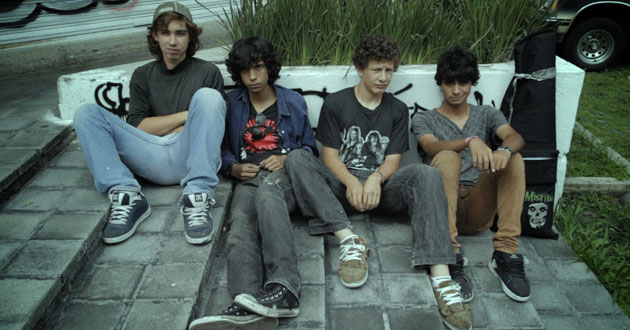
The Kids from the Port (Los Chicos del Puerto) Alberto Morais, Spain North American Premiere
In this charming neorealist gem set on the sleepy outskirts of Valencia, young Miguel and his friends undertake a seemingly simple mission on behalf of Miguel’s grandfather that teaches them all a lesson in real independence.

Ignasi M. Ventura Pons, Spain World Premiere

Ignasi M., a world renowned museologist, is living a dramatic moment, but has the capacity to turn any situation into an edifying one and any discomfort into a hilarious series of facts.

The  38th Toronto Film Festival takes place September 5 – 15th, 2013.  To see more of the festival films trailers check out their YouTube channel.

@TIFF_NET

#TIFF13

Facebook.com/TIFF

Morelia Film Festival unveils most impressive Mexican Competition yet

Screen Shot 2013-08-09 at 11.25.14 AM
Designed by Rodrigo Toledo based on Michoacana by Jesús de la Helguera

The 11th edition of the Morelia Film Festival (FICM) which will take place in Morelia, Michoacan October 18-27, announced its raison d’être  Mexican competition of 88 films consisting of 11 narrative features, 23 documentaries, 43 short films and finally 11 films in their Michoacan section, in which for the first time in its 11 years a feature narrative will compete.

Further proof the festival is at the fore of social media muscle and hipness, (FICM boasts the 2nd most followers on Twitter out of all international film festivals, second only to Sundance), FICM organized a Google Hangout to discuss the lineup announcement, forgoing the boring, stuffy press conferences that typically accompany festivals’ film announcements.    You can watch it here.   Festival Director Daniela Michel, Producer & Programmer (and film producer) Daniela Alatorre and Festival Advisor/Soulful spirit (and also a filmmaker) Alejandro Lubezki were onhand looking and sounding their ever poised, smart, warm, enthusiastic, professional selves.  The team underscored their deep appreciation and privilege of getting to know their beautifully rich and profound country via the images and stories of the filmmakers over the course of the festival’s history.  Coining this year’s edition as the “First year of the Second Decade”, Daniela Michel exudes a reinvigorated energy as she and her esteemed partners forge ahead in producing the most renowned, anticipated and beloved film festival in Mexico.

Screen Shot 2013-08-09 at 11.23.45 AM
Founding Festival Director, Daniela Michel

Since the program’s inception in 2007 (the festival did not include a narrative feature competition until four years after the festival launched in 2003), the Official Narrative Competition was exclusive to 1st or 2nd time filmmakers.  This year FICM opened it up, making room for such international superstars as Fernando Eimbcke and Michel Franco.   There are brand spanking new titles yet to premiere anywhere else like Paraiso by Mariana Chenillo, A Los Ojos by Michel Franco, and Manto Acuifero by Michael Rowe.  However, it’s hard to say if they will still be world premieres upon their Mexico bow in October since San Sebastian and Toronto are still unrolling their program selections.

Here’s a closer look at each of the 11 narrative features in competition

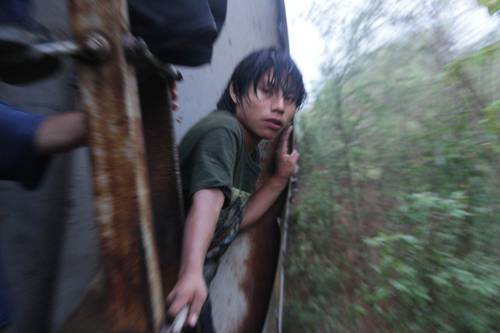
jaulaFrom this year’s Cannes Un Certain Regard, La Jaula de Oro by Diego Quemada-Diez, a startlingly authentic portrait of Guatemalan migrant youths traveling by “La Bestia, or Beast, what they call the dangerous train on which thousands hitch a ride on at their own peril.  A first feature by the Barcelona born filmmaker who has accumulated a host of experience with varying camera operator credits on Hollywood films and has notably worked with Ken Loach.  The film was called the unglamorous non-Hollywood version of Sin Nombre.

img_15949The Empty Hours/Las Horas Muertas is Aaron Fernandez’s second film after 2007’s Partes Usadas.  It was in San Sebastian’s treasure trove Works in Progress last year and is world premiering in this year’s New Directors competition. Shot in Veracruz, its about a 17 year old who has to caretake his uncle’s motel on a remote stretch of tropical coast.

Last year’s Cannes Un Certain Regard winner and Mexican entry to the Oscars was Despues Lucia by Michel Franco.  Apparently he had been working on A Los Ojos before then and it was actually tipped for this year’s Cannes per IonCinema.  Oaxacan actress Monica Del Carmen who gave a fiercely intense and breakthrough performance in Michael Rowe’s Leap Year stars.  Michel’s sister Vicky Franco co-directs.

64121_176095105896167_1265303641_nThe idiosyncratic titled, Amazing Catfish, Los Insolitos Peces Gatos by Claudia Saint Luce is a first feature and only one of two female directed films (not counting Vicky Franco) out of eleven.  A n unexpectedly heart tugging film about a solitary twentysomething who becomes inadavertently folded into a dysfunctional family household run amok by the single mother’s worsening health, she becomes an indispensable honorary family member which ensues with the typical sibling rivalry.  The film is world premiering at this  year’s Locarno film festival and according to sales agent Pyramide’s website, it will also screen at the upcoming Toronto Film Festival even though it is not announced on TIFF’s website yet.  Claudia is for sure a talent to watch!

mari-pepaSomos Mari Pepa which just had its world premiere at the Guanajuato Film Festival is drawn from the short film, Mari Pepa which endeared audiences all over the world and won Morelia in 2010.  An unassuming, empathetic, immediate yet nostalgic portrait of youth as they finish their last year of high school, having to grapple with the gravity of what to do for the rest of their lives. Another  discovery to look out for as this first feature is certain to launch the talented filmmaker’s career.

5.LaVidaDespues-LIfeAfterLa Vida Despues/Life After is from David Pablos, an alumni from the thriving film school CCC, Centro de Capacitación Cinematográfica and he is currently finishing up at Colombia NYC film school.  He co-wrote SKIN a mesmerizing short film which premiered at this year’s Sundance Film Festival, directed by Jordana Spiro.  The Life After  which will have its world premiere at the prestigious Venice Film Festival before its FICM premiere, is about two teenage boys who embark on a road trip in search for thier mother who disappears leaving nothing but a mysterious note.  Pablos’ previous film was the 2010 documentary Una Frontera, Todas Las Fronteras which premiered at world’s greatest doc festival IDFA in Amsterdam.  His short film, La Cancion de los Ninos Muertos played the Morelia Film Festival in 2008 and went on to win the Ariel Award in 2010.  You can watch it here

Workers played the Berlin Film Festival’s Panorama section and was notably in competition at the LA Film Festival by Jose Luis Valle. The film has a tinge of black humor in portraying a maid and a janitor who expect a retirement pension after decades of devoted service, only to take things in their own hands when they get shafted.  Like David Pablos, this is Jose Luis Valle’s first dramatic feature having first made a a documentary feature.  The Salvador born filmmaker who attended the most famous and oldest film school in Mexico city, UNAM’s  Centro de Estudios Cinematográficos (CUEC),  caught the attention of several Mexican festivals with El Milagro de Papa, a documentary he made when he read in the newspaper about a Zacatecas boy whose Leukemia was ‘cured’ by a visit from Pope John Paul II.

Screen Shot 2013-08-09 at 1.48.22 PM

The addition of feature length film Enero by  Adrián González Camargo gives FICM lots of personal pride since for years they’ve made grand efforts to strengthen Michoacan produced films by having a competitive Michoacan film category, resulting in today’s thriving filmmaking scene.  Adrian is not only an alumni and collaborator of the festival but he also run a series of indigenous film screenings in the Michocan area.  He will be attending CSU Northridge on a Fulbright scholarship this year.  The film sounds like a dark, on the run thriller about a man who kills his wife and hits the road with his lover, only to find that their own happiness together might not be their destination after all.

Screen Shot 2013-08-09 at 4.42.24 PMFrom Camera d’Or winner for 2011’s Leap Year,  Michael Rowe, the Australian born Mexico based filmmaker is back with his second feature, Manto Acuifero/The Well.  Shot in Puebla.  The film is about an 8 year old girl who longs for her father to return even though her mom has moved in with another man.  A well in the backyard of their house becomes a secret place that inspires her imagination.   The Well is one of two films produced by Canana in this competition.  Rowe has already secured funding for his third film, Rest Home which will be his first film in English

Penumbra – Shot on 16 mm this film premiered at the Rotterdam film festival and is currently making the international festival circuit tour including Edinburgh Film Festival.  Eduardo Villanueva’s previous film was the trippy, wildly intriguing and strikingly shot German/Mexican film Trip To Tulum.

club-sandwich Fernando Eimbcke is back with his third feature.  He made a big splash back in 2004 with his first feature, Duck Season, a jewel discovered in the 2004 Guadalajara Film Festival went on to play Cannes’ Critics Week, won AFI’s grand jury prize and won the Ariel for Best film.  His followup was in 2008 Lake Tahoe, a script developed at the Sundance Institute Screenwriters lab and which film premiered at the Berlin Film Festival where it won the Fipresci Prize.  Club Sandwich is only described as the growing pains relationship between a mother and her teenaged son.  It is set to world premiere in competiton at the San Sebastian Film Festival.

Screen Shot 2013-08-09 at 4.44.01 PMAnd last but certainly not least, I’m super excited for Mariana Chenillo’s sophmore feature, PARAISO.  Chenillo won the Audience Award at FICM 2008 with her beautifully dramatic and humorously pitched film, 5 Days Without Nora. It went on to be a hit at many international festivals and won Best film at the 2010 Ariel Awards (Mexico’s top film honors).  The film is about an overweight couple who move to Mexico City where they immediately feel the social pressure of being overweight surrounded by beautiful people. When they decide to jointly go on a diet, their relationship is put to the test when one of them successfully makes progress while the other continues to struggle. Produced by Canana’s Pablo Cruz.

Below is the list recapped with International Sales Agent info.

*Denotes first feature (Opera Prima)

Sección de Largometraje Mexicano

1. A los ojos. Michel y Victoria Franco
2. Club Sándwich. Fernando Eimbcke  (Funny Balloons)
3. Las horas muertas. Aarón Fernández (Urban Distribution International)
*4. Los insólitos peces gato. Claudia Sainte-Luce  (Pyramide)
*5. La jaula de oro. Diego Quemada-Diez  (Films Boutique)
6. Manto Acuífero. Michael Rowe  (Mundial)
7. Paraíso. Mariana Chenillo   (Mundial)
8. Penumbra. Eduardo Villanueva
*9. Somos Mari Pepa. Samuel Kishi Leopo  (Figa Films)
10. La vida después David Pablos
11. Workers José Luis Valle  (MPM Film)

Not to ignore the bread and butter of the festival, the docs and shorts – I’ll get to them in a later post.  In the meantime, to see the rest of the competition titles click here.

Viva Cine!  Viva @FICM!

#Outfest – Where my hip Latinos be at.

If you are wondering where to meet and connect with the hip, new Latino generation of film and television right now, the answer is LA’s very own Outfest Film Festival. So get your booty over here. It runs until this Sunday, July 21.  If you are not in LA, don’t sweat it, I’m on the beat, finding out about all the crazy Latino talent coming up.  On the screen, and in the DGA Atrium where most after-screening receptions are being held, I got the chance this weekend to discover and meet some really fierce brown talent.  I was pleased as punch to look around me and see faces and bodies epitomizing the spectrum of LA diversity on so many levels, not just “Hollywood”.  Old, young, singles, couples. Sure you got your beefcake WeHo boys with jaw dropping sculpted bodies, fine ass butch and girly lesbians who look like they walked off the set of The L Word (and who I secretly wish would  hit on me), and fabulous transgender artists, but what’s more exciting to behold is the plenty of ‘regular’ folks whose unquestionable magnetic air of confidence, smile and style compete for my undivided attention among this colorful crowd.

I’ll be down there all week to meet more folks and hopefully get some video and more intimate conversation regarding the stories being told. For now, lets put these three on the spotlight:

Eloy Mendez
Eloy Mendez on the left, Polo Munoz of LatinoWeeklyReview.com

ELOY MENDEZ

Outfest’s Opening Night film last Thursday was C.O.G which premiered at this year’s Sundance Film Festival and is directed by Cuban-American Kyle Patrick Alvarez (Easier With Practice).  Its the coming out and of age story about a college boy, David (based on David Sedaris’ short story) who goes on a sabbatical like journey to spend a summer picking apples.  Naturally the people he encounters on the fields are Latino. Instead of being relegated to background characters, however, Eloy Mendez plays Pedro who embodies him vividly, affecting David’s inner work in progress.  I met Eloy and learned that this role has opened  new doors from him, after years of working in television and film.  BIG SCOOP: He will next be seen in Mike Ott’s upcoming film, Lake Los Angeles, which apparently is mostly told in Espanol!  Mike is the visceral director of such festival faves as Little Rock and Pearblossom Highway.  I applaud Ott’s efforts in making this film in another language, and for really exploring and mining these stories of unanchored souls caught in the greater desert mountain landscape of Los Angeles.  Make sure to check out Lake Los Angeles Facebook page to find out where it will be premiering in early 2014.

Robles

AUGIE ROBLES

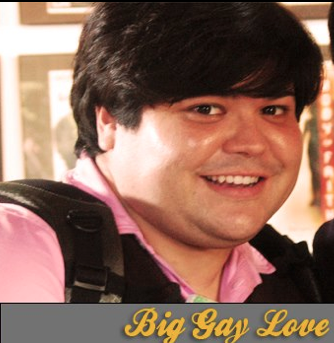
Augie Robles graduated from AFI Film school, made a few short films then landed a gig on CSI which ended up being 14 years during which he sharpened his cutting skills as an editor, and became restless and eager to tell his own stories again.  He recently did his editing magic on Aurora Guerero’s film, Mosquita y Mari which y’all know how I feel about. (love).  He edited the film, BIG GAY LOVE  which just premiered at Outfest, directed by Ringo Le and starring Jonathan Lisecki in a super sweet and tender love story about a hopeless romantic in LA who struggles to fit into LA’s lofty pressure and idealized gay man archetype.  Back writing and directing his own work, Robles recently screened his short film,  The Rookie and the Runner, set in Elysian Park at a number of film festivals.  He also has plenty of other projects in the works, including something a la Twilight Zone !  He has a lot of technical and narrative genre skills to unleash in his own voice, and I find it really sweet that he is sharing his wealth of experience as a mentor for Outfest’s program, Outset, created to empower and educate LGBT youth(16-24) to tell their stories through film.

HARVEY GUILLEN

In a show stealing/stopping cameo in Big Gay Love, Harvey plays a kid who represents the essence of gay youth who try with all their might and ferocity every damn day to battle and defy mainstream society’s twisted dictation of what normal, perfection and beauty should look like.  Encapsulating perfectly how important it is to see people like you in order to not feel alone is a bigger theme of the importance of Outfest and for that matter, a diverse representation.  Harvey can next be seen in Pantelion’s luchador comedy, Aztec Screen Shot 2013-07-15 at 8.50.24 PMWarrior directed by Scott Sanders (Black Dynamite) starring Luis Guzman and gorgeous Nadine Velasquez.  You might know have seen him in The Internship and on 2010 ABC Family television show, Huge.  He is absolutely charming, playful and a bon vivant with a deliciously fierce streak.

REFLECTIONS OF: Outfest is truly LA’s most inclusive and community driven festival.  Not just for the LGBT community but the organization picks up the slack of other festivals by embracing many underrepresented multi-ethnic voices.  The AFI Festival is a wonderful showcase of international film but as an extension of the film school, it has positioned itself as a program driven for cinephile-centric and auteur platform.  Meanwhile LA Film Festival certainly offers big broad fare for everyone, but also tries to inch in on AFI’s international showcase turf. Don’t get it twisted, I was really happy to see LA Film Fest screen three U.S. Latino films this year.  But just think how much more impactful it would be to tap into the U.S Latino film representing the rich and underplayed walks of life AQUI in Los Angeles.    Films like Water & Power, Vincent & Luzy and Pardon are really original and telling narratives with a distinct aesthetic, and all three have yet to have their official premiere even though they’ve been submitted to the festival circuit.  While I don’t think its reasonable to rely on the big distributors to be the platforms of discovery for these films, I do believe that festivals on this scale have that cultural responsibility, or at least it should behoove them to do so.  An often heard comment that I take issue with is that a film has to be ‘good enough’ to show at these festivals.  Every film is imperfect so this does not hold agua with me when we are talking about the discovery and expanding of marginalized voices.   I previously reported that The Los Angeles Latino International Film Festival has announced it is currently taking submissions after its sudden shutter last year. There is no doubt there is a sizable hungry audience and community for these films, and filmmakers who want their films to be seen by them, so even though its bewildering to me that LALIFF does’t have their festival dates set yet, I’ve a feeling they will still be looked to as the last beacon and chance for the array of Latino filmmakers and stories in LA trying to emerge through the bottleneck.

#LAFF2013 Tapia – The Indomitable Spirit & Legacy of Johnny Tapia

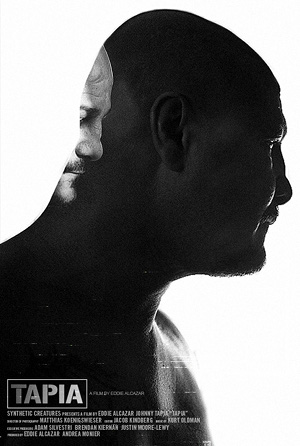
TapiaPoster-thumb-300xauto-33284The brief and tumultuous life of prizefighter Johnny Tapia, who passed away last year at the age of 45, elicits overwhelming empathy and incredible awe.  The documentary directed by Eddie Alcazar, intimately reveals the immense emotional agony and pain he suffered in his life but also shows that for the series of extreme, rock bottom lows of misfortune, Johnny always jumped back up to reach equally extreme heights of success and triumph, like winning five boxing championships, meeting the love of his life, Teresa Tapia, with whom he has a young son, and becoming a beloved hero to his hometown Albuquerque, as well as around the world.  Johnny grew up without a father, and his mother was the world to him.  At the tender age of 8, his mother was viciously murdered – a traumatic catalyst for what became the pang of his tortured existence. The documentary, which is world premiering in competition at the Los Angeles Film Festival, is powerfully narrated through Johnny’s own words.  Alcazar adds a touch of style and a gorgeous cinematic framework.  The film opens with Johnny’s slightly raspy Burqueño slanged voice over young Johnny Jr. punching the air in the New Mexico desert plains and celestial horizon captured in wide panoramic vista at the magic hour, painting a metaphysical element to the legacy he leaves.

Screen Shot 2013-06-21 at 12.08.11 PMEddie was working on a dramatic feature about Johnny but after he passed, Eddie took the research footage and made it into this documentary film.  The dramatic feature, which he is co-writing with Bettina Gilois, (Glory Days, The Hurricane) who co-wrote Johnny’s biography, Mi Vida Loca is readying for a fall shoot in Albuquerque.   50 Cent is an executive producer on the documentary and is also onboard for the dramatic version.

Teresa&Johnny JR
Teresa & Johnny Jr. at the world premiere screening

The documentary is gripping and utterly poignant. Hearing his inner, unwavering fury takes on a dark possession.  His voice and soul feel weary but he is unrelenting against the demons he waged battle with every single day of his life.   Seeing him from his early days rising up through the boxing world first as the “Baby-faced Assassin” to his later years as the lines of anguish take over his face and his body becomes heavily drawn with symbolic tattoos, his killer instinct clashing with his vulnerability. At the world premiere screening, his wife Teresa and son, Johnny Jr. came out to introduce the film but did not return after the screening, as much as everyone wanted to see them.  I wasn’t surprised to learn that it was too overwhelming for them and Eddie declined to do a Q&A out of respect, feeling that what’s important in the doc is Johnny, and Teresa is the only person who could talk about and for him. He told me that a couple days later when I got the opportunity to interview him.  I learned the ABQ native has some Bolivian lineage and found out more about both Tapia films.  Here’s a redacted transcription of our talk:

How did you know Johnny, how far did you too go back?

I never actually met him until I knew I wanted to do a movie two years ago.  Back then it was about creating the narrative version of his life so I sold him on my idea of doing one year of his life in his youth and he was totally up for it.  Then I got the rights and we basically just started following him around at that point. As I was following him around I was writing the script.  It was all about research and compiling all this archival footage.

Relating to him.

A lot of it is because he embodies the Albuquerque culture, which is a little bit different. Having somebody that stands out from ABQ is always kind of special and he definitely kept it real from his upbringing so I think that’s why everybody in ABQ has that strong connection with him and each other.  It’s distinct.  The community always looked up to Johnny. There is no professional football or baseball team and he was one of the first professional athletes who came out of that area.  More than seven thousand people came out to his funeral.

SamFloresTapia
Kick ass image by Sam Flores.

How did you manage to contrast the darkness of his life with all the other light and positivity he also experienced?

It was tough, which was I never intended to do the documentary. I wanted to concentrate on one year of his life because there is so much to his whole life, and it was a really really hard process confining everything that he’s been through so I was experimenting and discovering it as I went.  Bu there are as many highs as there is lows and his life in particular is filled with many from each side of the spectrum.  As far as my experience with him I never saw too much of the dark side other than when I interviewed him.  I mean personally it was just fun, just me and him playing around.  He was always active, jumping on the trampoline, playing ping pong, when we’d go out to eat he’d shake everybody’s hand. He really couldn’t stay in one place for too long.

Doc vs narrative, what do you intend to do with the dramatic feature you weren’t able to do with the documentary

filmThe documentary was about trying to hone in on what he said and having him say it directly to the audience. I didn’t want to interrupt anything too much.  We did a little bit of stylistic stuff intertwined to show a little bit of the spiritual side, you know like his connection to his son, and his connection to nature. But I wanted to keep it pretty loose on that, only scratching the surface of what I’m going to do in the feature. The feature is going to definitely be a little dreamy and spiritual.  When I say spiritual, there’s this thing that I recognized when I would talk to Johnny, I was always trying to pin point how his mind works – and he feels like his mother is right next to him.  So that plays a large role in the actual film; the presence of his mother, always around and also that connection with his youth.  In the feature as its written now we pop back and forth in his life from Johnny at 27 years old, and when he was 8 years old when he lost his mother. Its always trying to establish the connection of where he finds all this anger but also power, passion and energy that was super important to have. That drives every action in his life, I think, from that point forward, and I’ve had conversations with people who agree he became stunted at that age.  He still felt like an 8 year old when I’d talk to him, he had a child like spirit, insight.  He was not that formally educated, he was street smart, he improvised with whatever was around him.  He had that excitement, wonder and would be happy to see someone looking to give him love, and made people happy.  He was always surprised at any good news.

In a way its hard to imagine him as anything but a boxer, literally pounding and fighting his demons…

He was really hyper, boxing was a natural thing for him, it was a natural release of energy, it was actually perfect, getting into the ring, always training is what kept him alive.  It’s hard to think of him as anything else, maybe some other kind of athlete.

1013712_478296282260088_1376259146_n-1
Curtis Jackson at the second screening; “It was so interesting to see someone, 3 weeks before they actually passed, reflect on their entire life.”

How did 50 Cent come on board?

It all came through Lou DiBella, (executive producer) the boxing promoter and tv/film producer.  When we finished the film we started showing a handful of people to get people’s thoughts on it.  Lou was actually head of the HBO sports division who helped put together the infamous Johnny Tapia/Danny Romero fight back in the day so he had that connection. He showed the movie to 50 cent with who he has a partnership… 50 felt all these similar things and really connected with what Johnny went through (they both suffered the loss of their mother around the same age).  Also he grew up in similar crazy circumstances.  Its weird how you connect the dots….

Tell me about your producer Andrea Monier

Yes, Andrea Monier has been pivotal. We are friends, she’s also an actress but an amazing producer.  We worked on an Everlast spot first and she did an amazing job.  To do a documentary you have to have a super strong producer because there is a lot of work like archiving footage, etc. I couldn’t have done it without her.

AkiraBeard
And this amazing artwork by Akira Beard

Describe the driving creative process in writing the narrative

(Losing his mother)  that’s the biggest thing.  All his issues stem from that; drugs, psychological conditions, we explore a lot of him meeting and falling in love with Teresa.  It’s a big part of the film; the love story, but then that also connects to the mother. There’s a lot of similarities between Teresa and his mother as far as the expectations Johnny had, he almost felt like Teresa was his mother, she replaced her in a way.Feeling like a baby with your mother, a lot of the treatment you get from your mother at that age.  I come from a single parent as well and it helped me a lot to realize how much Johnny valued his mother.  Like, I don’t’ know where I would be without my mother, those thoughts always trickled through my head.   Johnny was super proud to have Teresa next to him as his woman.  I don’t think he ever constricted her in any way.  She was more the person who kept him in place, she was the one who handled the business and dealt with the promoters and he looked up to her in terms of what direction to take. He trusted her opinion above all.

What do you think she saw in him?

She likes to joke that she was young and stupid but I know there’s a lot more to it.  She has all the traits that he may have needed help on, and likewise, he showed her the excitement, spontaneity that she was looking for in life, and that quality of never expecting or knowing where the day is going to go was interesting and that’s what she gravitated to.

It must have been hard to watch him fight all the time

Screen Shot 2013-06-21 at 10.26.44 AM
Eddie Alcazar

Well, the professional aspect is almost better than the day to day reality in ABQ.  There are worse street fights, guns involved.  Every time I’d go to a party there were gunshots. I wanted to show this world that is not familiar, Breaking Bad does it a little bit but its not as dark or raw as it really is.  (ABQ) is a beautiful place but it’s a weird thing; there’s this subculture, an underbelly. It has a big native American population, Spaniards, Mexicans, I don’t know what leads to so much conflict but maybe the biggest thing I can relate to is there’s not too much to do. So people just …they are bored and act crazy sometimes.

Big thanks to Eddie for the interview. LA folks I urge you to go see Tapia tomorrow night, Saturday at 9:50pm at the Regal at LA Live.  Get tickets here.  Details on the big ABQ screening forthcoming.  Also be sure to queue it up on GoWatchit and like it on Facebook to support it and to get updates on where it lands with its theatrical/television/VOD release.

#LAFF2013 Diversity Speaks – People Like Us

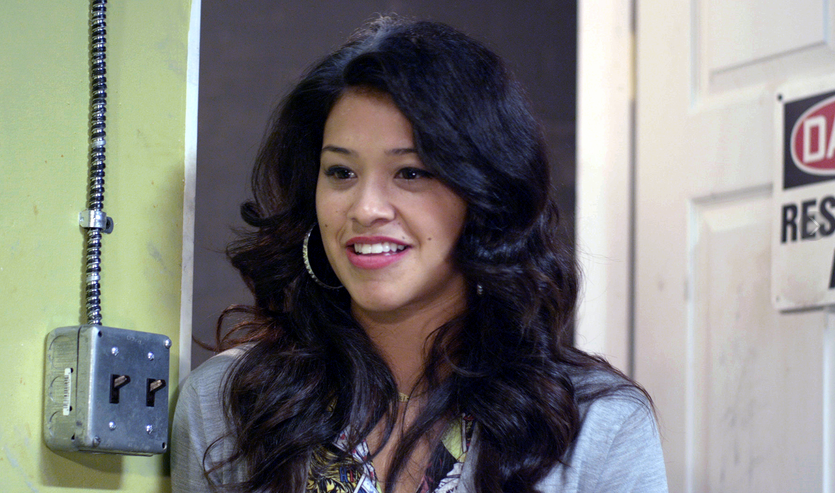
My header above; “People Like Us”  comes to mind and becomes a play on words at the same time.  At a couple LA Film Festival panels I heard both actor Gina Rodriguez (Filly Brown) and filmmaker Ryan Coogler (Fruitvale), hit on the personal impact of seeing stories embodied by and created by ‘people like us’ as being their driving creative force.  Ryan did not personally know Oscar Grant, the Black 22 year old who was ‘accidentally’ killed by an incompetent Oakland police officer on the Eve of 2009, but says that he was ‘like him’. The frightening thought that this incident could have happened to him is what compelled him to make his first film about this tragic and unnecessary death.

The other way I might mean “People like us” is using ‘like’ as the verb.  As humans we have the remarkable ability of feeling compassion and human connection to someone’s narrative regardless of whether we share a common culture.  There should not be any fear that if you are too specific i.e. too Chicana, too Puerto Rican, other people (audience) won’t like us or our stories.  As Ryan points out in the clip, just because a film is about all about a Puerto Rican family in the South Bronx, referring to The House that Jack Built, it doesn’t mean that a non-Latino would not enjoy it, or identify with the pains of a dysfunctional family and a nostalgia for one’s childhood.  The clip is from The Blackhouse Foundation series of ” Diversity Speaks panel that took place last Saturday.  Joining Ryan Coogler on this “New American” Independent panel were filmmakers Grace Lee, director of American Revolutionary: The Evolution of Grace Lee Boggs (who was quick to point out that the Black community has it so good compared to Asian-Americans in media representation), Henry Barrial (The House that Jack Built), Ava Duvernay (Middle of Nowhere) and the gracious moderator and producer Effie Brown.  I’m always trying to take note and learn from the LGBT and Black community with regards to how they address their representation in the media.  I find that both communities share a stronger solidarity.   Perhaps that’s because for some time now, they’ve moved past dwelling over lack of their lot and instead, collaborating with each other, which in turn, better improves their lot.

The signature LA Film Fest panels, Coffee Talks are general conversations about the craft and opportunity to hear from successful artists in their respective fields.  I stepped into the Actors one which consisted of Garcelle Beauvais (White House Down, Flight), Joe Manganiello (True Blood,Magic Mike), Gina Rodriguez (Filly Brown, Snap) and Andre Royo (The Spectacular Now, The Wire). Even without the “diversity’ header, hearing their different trials of pursuing their art, highlighted the disparity for people of color.   As members of a ‘minority’, artists must chip away every damn day at the resistance of a media in which white men continue to dominate opportunity.  When asked how they choose their roles, Joe Manganiello, the insanely rugged handsome man’s man, said that for him the most important decision factor is the director.  Now of course, that sounds like a valid answer for many reasons. It’s in some way a privilege to be afforded that choice.  But for the other brown and black folk on the panel they commented it was far less a choice for them because for one, they do not get offered roles as much.  And two, when they do, they must grapple with the trying decision of whether to keep accepting the few roles that come their way which perpetuate the same degrading stereotypes. All actors probably struggle with finding work that does not sacrifice their individual integrity, but this is such an added pressure and obstacle.  As Andre Royo said, most roles he’s been in are either where he’s in jail, coming out of jail, or going into jail.  If his character is not high, he’s happy.    Listen to what Gina says:

#HotSec Fridays – web series American Nobodies episode Antonio by Robert Machoian and Rodrigo Ojeda-Beck

In honor of their very first feature Forty Years From Yesterday debuting at the LA Film Festival this week I want to share this particular mini-doc portrait made by the filmmakers Robert Machoian and Rodrigo Ojeda-Beck.  In distinct auteur meets D2F fashion, American Nobodies is an original web series in which they film and introduce us to “Average Americans Doing Extraordinary Things” then upload them online for free for everyone to see.  In little over a minute they manage to capture and highlight the startling souls of individuals as the camera unyieldingly gazes directly into their eyes, and follows them in their element.  We get to meet Don Antonio in this one, a weary, aging man who recounts his grueling 9 day trek across the US – Mexico border.  Even though it must be decades since the terrifying ordeal, we can tell the experience will forever and firmly remain embedded in his memory.  Meet Antonio and check out more extraordinary Americans here.

The boys from NoCal have a considerable body of work in multi-media short forms that defies and blurs through genres, demonstrating a love and anthropological eye in its dreamy realist cinema.  It’s always awesome to see short filmmakers take their craft into the feature form, especially ones with such original voices and aesthetic. The world premiere of Forty Years from Yesterday is this Sunday at 7:30pm.  Get tickets here.

NICOLE GOMEZ FISHER WINS BEST DIRECTOR AT BROOKLYN FILM FESTIVAL

Tonight the Brooklyn Film Festival drew to a close and I’m so thrilled to hear the news that Nicole Gomez Fisher was awarded BEST DIRECTOR for her debut feature, Sleeping with the Fishes starring Gina Rodriguez!  In case you missed it you can ready the interview I did with Nicole last week here.

Festival wins for indie films often help the visibility and future of their distribution. Make sure to like the film’s FB page to stay tuned for future announcements on where we might see the film next.

Cast:  Gina Rodriguez, Ana Ortiz, Steven Strait, Priscilla Lopez, Tibor Feldman, Orfeh, Producer: Courtney Andrialis – Director/Screenwriter: Nicole Gomez Fisher – Cinematographer: Raoul Germain – Editor: Carlos Berrios,

Email:  swtf13gmail.com

Untitled

NALIP 2013 PROMISES DISCOVERY AND DEBATE

NALIP posterThe National Association of Latino Independent Producers (NALIP) is ramping up for its 14th Annual Conference this weekend and to my great gusto, the discourse promises to be more specific, relevant and fresh than last year on how to empower Latino independent storytellers. Judging by the practical and forward-thinking panel discussions, NALIP’s Official Selection YouTube channel showcasing a curated selection of current film trailers, and the hip, savvy talent invited to represent, NALIP is setting the tone for discovery and healthy debate.  Chief among the themes will be a contextualized creative response to the much-propagated Latino trillion dollar purchasing power statistic, and how to strategically seize territorial claim to the wild wild west expansion of online distribution platforms.

Pena
Bebeto Matthews/AP

Among the established and rising American Latino actors and filmmakers on tap are Richard Montoya, Cristina Ibarra, Aurora Guerrero, Gina Rodriguez, Danny Trejo, Jeremy Ray Valdez, and Jesse Garcia.  The keynote speech on Friday will be given by none other than Richard Peña, one of the most influential film curators in the world who headed the prestigious Film Society of Lincoln Center for twenty-five years.  It will be an insightful and thoughtful conversation moderated by the sensitive, masterly formal documentarian and MacArthur Genius Grant fellow, Natalia Almada.  As this year’s NALIP Conference Co-Chair, Almada helped inform the direction of the conference and scored Peña’s participation.  When talking about how each year’s conference organically takes shape with the feedback of board members, staff and hosting committee, Beni Matias, Acting Executive Director of NALIP, referenced Natalia’s concern of prominently featuring the voice of the independent filmmaker over the commercial as a guiding pursuit.

Natalia’s involvement with NALIP goes back to 2003 when she became the recipient of the Estela Award, given in recognition to an emerging filmmaker who has ‘arrived’. Her revelatory documentaries include El Velador, El General and Al Otro Lado – all which have been critically acclaimed worldwide and have been featured in museums and screened at film festivals including Sundance and Director’s Fortnight at the Cannes Film Festival. I asked her to share a few words about NALIP’s import and she replied over email, “I think that more than anything else the conference is a place where we can really exchange ideas, address shared concerns in our community and collectively fuel to keep going”.

Natalia is part of the sub-cine filmmaking crew who came of age through NALIP like Cristina Ibarra, Alex Rivera and Bernardo Ruiz. In fourteen years the organization has managed to be one of the few consistent Latino forums which has nurtured a family of artists/active organizers.  Along with Beni Mathias, Maria Agui Carter who is a filmmaker and the Chair of the Board of Directors, has been actively with NALIP since the beginning.  Other members who have continued to be involved with the organization since the beginning include Louis Perego Moreno who use to spearhead chapter leadership meetings, Jimmy Mendiola filmmaker and Director of CineFestival in San Antonio, Frank Gonzalez from Disney/ABC, Kim Meyers and Terri Lopez at WGA, Alex Nogales, to name just a few. NALIP has also enjoyed a sustained relationship with Time Warner and HBO who have taken turns at being the presenting partners of the conference since 2000.

Part of the reason I’m so eager to engage with and synthesize this year’s theme is this following text written by Maria Agui Carter to describe the Opening Plenary:

“Forbes magazine has called the Latino Market the “New Media Jackpot.” What is at stake? Why is every network and cable outlet now chasing the Latino market and how are Latino voices participating in this explosion not just as consumers but as creators?

There it is:  “But as creators”.  Amid all the hoopla over the rising Latino market data that makes corporate brands salivate over how to exploit us as consumers, I have yet to hear any of us fashion a reckoning of a counter creative force.  We should be imagining how to harness, demand and unleash our creative power with that kind of purchasing power.  Instead, the data is being used to make us a target of a non-stop branding attack in which the depletion of our capital power and identity is at stake.

Aimed to provide a more significant showcase for Latino filmmakers, NALIP is spotlighting recent films on their NALIP YouTube channel.  They’ve done away with the NALIPsters On View programming where members could openly screen their work during the conference.  Those screening rooms tended to be lightly attended since there was little visibility and competition from the panel programming. Instead, this year NALIP will be uploading trailers of current and upcoming films starting Thursday, June 6.  The plan is to build buzz and promote the curated selection of 15 documentaries, narrative features and shorts.

W&P

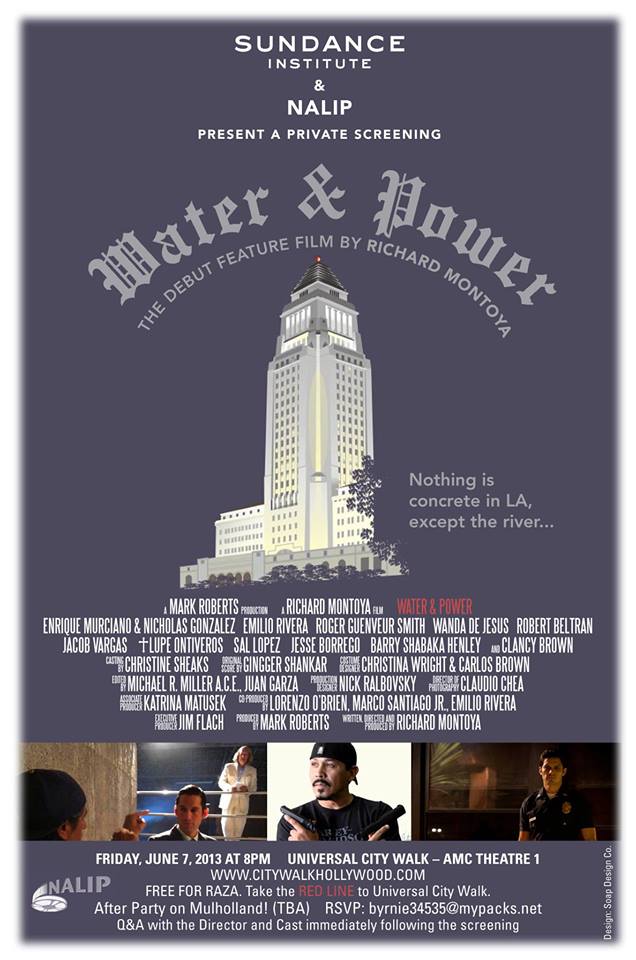
Without a doubt, the most anticipated happening of this year’s conference will be the NALIP and Sundance Institute screening of Richard Montoya’s debut feature film, Water & Power at the AMC CityWalk.  The impact and influence of this Chicano icon will be evident by the droves of fans, familia and homies, a wide range of community activists, artists and politicians who will be in attendance – La raza who reflect the young and old blood of the characters he writes.  I listed W&P as number one in my top five movies to watch out for in 2013 so I’m thrilled to see it screen this way.  Richard Peña will moderate a Q&A with Montoya after the screening.  I couldn’t think of a better filmmaker and moderator pairing.

On Saturday at the Awards Gala, Machete Kills star Danny Trejo, the menacing but actually sweet hood actor will be presented with a Lifetime Achievement Award.  Aurora Guerrero, filmmaker of Mosquita y Mari will be honored with the Estela Award that comes with a $7500 grant from McDonalds.   And in what will surely be an emotionally inspiring moment, the first ever La Lupe Award will be bestowed to Gina Rodriguez.  Her effervescence completely evokes the spitfire tenacity of the late great Lupe Ontiveros.  I couldn’t think of a more perfect homage and passing of the torch.

While I found last year’s panel topics all over the place, this year it feels more targeted and practical.  Panels like Beyond The Latino Market: Getting Your Film Out To A Wider Audience with Gabriel Reyes, Writing on American Latino films moderated by Carlos Gutierrez of Cinema Tropical, the leading cross platform company promoting Latin and Latino Cinema (and yours truly will be participating!), Whatever It Takes: DIY Technology and the Democratization of Content Creation, Major writing programs and initiatives at networks and studios for writers.

On Sunday the Closing Plenary will be Latinos and Media Stereotypes in which Natalia Almada, Richard Montoya, Maria Agui Carter, Yancey Arias will participate and moderated by Mandalit del Barco of NPR.  These are all highly experienced, opinionated individuals with distinct tastes and critical contribution to content so I expect this to be one of the more livelier talks.

Overall, this year’s NALIP conference is about to go off!

NALIP 2013 Spotlight on the Trillion Dollar Latino Market will take place June 7-9 at the Universal Sheraton Hotel.

For a full list of speakers and panels here available at http://conference2013.nalip.org/conference/keynotes-speakers/

To find out more about NALIP click here

OJOS! Sneak peek at Gina Rodriguez’s new comedy and interview with director Nicole Gomez Fisher

nikniksmileUnveiling at the Brooklyn Film Festival  this weekend is the world premiere of SLEEPING WITH THE FISHES, the directorial debut of former stand up comic and actor, Nicole Gomez Fisher.  Gina Rodriguez plays the hilariously real and spirited star of the movie, Alexis Fish, a role she booked right as Filly Brown started making waves at film festivals last year.  A great cast of women join her including Tony Award winning stage and film actor, Priscilla Lopez who plays her mother, and Ana Ortiz (Ugly Betty)  who is enjoyably pert, as Gina’s sister.  Sleeping with the Fishes is also the first feature produced independently by Courtney Andrialis, a rising producer with many more exciting projects in development (she started her career as assistant to Bingham Ray in 2003).  I gotta say, I just love the female power of this film!   Check out the just- released trailer of the film, and read the interview I did where I check in with Nicole, a week before she releases her first baby (film) into the world.

How did your Latino/Jewish background and childhood inform your creative expression as you started conceiving of your first feature?  

I was born and raised in Brooklyn…a true Brooklynite at heart. My mother is Puerto Rican and my father is of Jewish descent, an interesting mix that has clearly influenced my life and my writing. I don’t necessarily identify with one over the other…both sides make up who I am. I knew when starting SLEEPING WITH THE FISHES that my background and my point of view wasn’t a filmmaker’s voice heard too often. I wanted to express myself and tell a story about a young woman trying to find herself in a world that she felt excluded from…not only from the outside world, but from her immediate as well.

 Screen Shot 2013-05-28 at 9.51.42 AMWhat’s your connection with Gina?  How was it to work with her in comedy?  She’s got great timing and tons of energy.  

I did not know Gina Rodriguez before making SLEEPING WITH THE FISHES. We met through our casting directors Sig DeMiguel and Steve Vincent. Her agent read the script and loved it, passed it on to her and BOOM!  A meeting was set. We actually met in the bathroom of Rosa Mexicana and it was love at first sight! Gina was incredibly energetic, bright, enthusiastic and funny! I was excited to work with someone “fresh”. I knew before we even ordered that we would work well together. She was just coming off the Sundance premiere for “Filly Brown”. It was an exciting time for her and it showed. She’s a natural when it comes to comedy, so she made directing incredibly easy. Gina’s choices were spot on and she just understood the timing of comedy. It takes a real pro to know when to “go there” and when to pull back and she did. I would say try this and within seconds she would make a slight adjustment and go. If she thought something didn’t work or wanted to try another shot, we went with it. Collaborating with her was such fun.  She made directing my first feature a pleasure.

The tale of a 30something whose life has not gone as expected and must deal with the pressure of returning to a childhood like dynamic at home with the parents, is so relatable and universal, but it can also be quite personal and individual, how personal is this screen variation to you?  What did you want to convey that you had not typically seen in this popular canon?  

Screen Shot 2013-05-06 at 10.55.19 AMIt’s personal. The story itself is loosely based on my family, but there are many aspects to it that are a mix of truth and fiction. For my lead, Alexis Fish (played by Gina Rodriguez), her coming back home after years of living a lie all in the name of “saving face” is paralyzing for her. As you mentioned, her resilience to stay true to herself has been an exhausting journey.  Having to deal with the loss of a loved one while trying to pick up the pieces of your life only makes it that much harder to overcome. I wanted to take a classic story and make it new. Yes, she is returning home to the pressures of family, but in Alexis’ case, returning home to her mother is what is so daunting. You have two strong women who don’t see eye-to-eye: one whose pride identifies her, the other whose pride is crushed as she struggles to find her identity.

 I love that you chose to do your first film a comedy.   There doesn’t seem to be as many first films as comedies tackled in the indie world, and even less from a female written and directed perspective.  What are your influences in this vein?   Also, what is it about our passionate Latino culture in particular you think that makes family dysfunction so melodramatic and ripe for comedy?

I was a stand up comic for years and I love writing comedy. I’m a huge fan of films that blend comedy and drama. It’s what life is made of—the ying and the yang.  Some of the funniest moments in life are also the saddest.  When you can stop and laugh at a time when hope seems dim, that is life changing. Laughter has pulled me through some really hard times. …Where there is passion, there is drama. From my experience, Latinos are very strong-minded, very passionate and very vocal about what we believe.  The combination makes for some terrific melodrama.  It’s who we are—they go hand in hand.

 Who were some key collaborators and mentors for you during the launching of your first feature?  Tells us about Courtney as producer – she’s from HD net films, how did you two bond about the making of this film?

Screen Shot 2013-05-28 at 11.14.33 AMSome of the key collaborators were my husband Joe, my friend and fellow screenwriter A.J. Meyers, my casting directors, my father and of course, my producer Courtney Andrialis. Courtney and I have built a solid relationship around SLEEPING WITH THE FISHES. I met her via our casting directors. She’s young, eager and has a ton of knowledge. She was an integral part of the making the film. She brought on an amazing team that held me up throughout the entire process, which for a first time director is so integral. There were a lot of learning curves for me. Courtney did a great job of keeping me together and supporting me throughout the entire process.

 As you navigate the wild west of distribution, how are you feeling and where are your expectations with getting the film out there?  Are you going to be exploring the newly paved roads of direct distribution models or pursuing the traditional theatrical and window route?  

It’s great that now filmmakers have so many ways to reach their audience.  We are excited for our world premiere at the Brooklyn Film Festival on June 1st.  After that, we’ll keep our fingers crossed and see!

Best of luck with the film and have a blast at your premiere, Nik!

For tickets & screening info (June 1 is sold out, but June 8 still available for all y’all NYers)

Film Contact: swtf13@gmail.com.

Website

Facebook

Twitter

Reel Rasquache – the only REAL LATINO festival on the block

970384_414758178623111_2140444442_n
Delusions of Grandeur after party

Latino Film Festivals have always lumped together international films and American films under the same Latino category.  As if the Latin prefix used to classify the totally different identities of South & Central America, Cuba, Puerto Rico and Spain was not already broad enough.  The few indie US narratives selected inside these programs look scrappy compared to the Spanish-language, art-house films which boast a higher production value due to their country’s government film subsidies.  It’s like  forcibly pressing two pieces of a puzzle together, when they clearly don’t fit.  These two kind of films do not lend themselves to the same audience.  Which is why I’ve always sensed the US Latino film in this platform is treated like an adopted stray.  Up until now, I had not heard of any sustaining film festival devoted entirely to American Latino (I’d love to be corrected.  If you know of any, give me a shout!). Enter the Reel Rasquache Art and Film Festival in East LA.  Leave it to the activist Chicano studies curriculum track at Cal State to oppose such a disparity of their representation and say, oh Hell no, by way of their actions.  They galvanized the community and wrestled a space for a showcase, led by the efforts of Dr. Richard T. Rodriguez and Dr. John Ramirez, who in 2004 christened the festival with the name Rasquache, derived from the Native American Nahuat people.

Front
The one of a kind Award trophies sculpted by Yolanda Gonzalez. click to go to her website

Sadly, I was not able to attend the entire jam-packed weekend festival that took place May 17-19, but I did manage to make it to the closing night and awards ceremony on Sunday.  I arrived to see Counterpunch, a film dramatizing the real life story of an undiagnosed, bi-polar boxer – the latest film by Kenneth Castillo who was bestowed with a Trailblazer Award.  Other Awardees of the evening; the Lifetime Achievement Award went to Carmen Zapata who was not able to attend but were assured by her friends accepting on her behalf she was fine and dandy in her 80 years young age. The Pioneer Award was bestowed on a colorful and lively Pepe Serna.

In the crowded, over-awarded Hollywood landscape, I’ve usually found awards, arbitrary or unwarranted, and just an excuse for a gala event driven by money and press.   And within the ‘Hispanic Hollywood’ circle, the awards tend to be given to the same artists over and over, celebrated BECAUSE they have (already) been recognized by the mainstream.  I’m not saying the breaking of barriers is not a triumph worth celebrating, but the days of Rita Moreno and Ricardo Montalban is long past (40 years).  In this day and age, we are bigger and stronger in numbers and we should be using our ‘purchasing power’, to demand our content and taking back our history.  It’s much more constructive to empower those who the mainstream forgets, dismisses and generally fails to acknowledge.  Those, who despite the lack of mainstream recognition, persistently continue to craft their art and who do not shy away from identifying as Chicano, Puerto Rican, whatever their bi-cultural origin may be. Although I’m embarrassed to admit, I share as proof to my argument:  Until Sunday night, I was not familiar with Kenneth Castillo – a genuinely independent working director who is about to shoot his seventh feature this summer. And worse yet if someone were to have mentioned to me Pepe Serna or Carmen Zapata –I would not have been able to place the two veteran American actors –  both of whom have forged incredible careers that span over six decades within both mainstream and indie theater and film.  Thanks to Reel Rasquache’s recognition of their talent I am now turned on to their work.   It allows me to connect the dots of the history of American Latino entertainers, who have been and continue to be so harshly forgotten and suppressed from mainstream history and therefore our collective psyche.

It was my first time at the new location of Casa 0101, the cultural center founded by writer Josefina Lopez. A comfortable 99 capacity seat theater is located at the end of a a long hall on which walls hangs an arresting series of artwork.  On Sunday it was the paintings of Juan Solis whose palette provided the signature theme of the festival this year. Kiki Melendez, a saucy comedienne and 96.3 Latino radio personality emceed the festivities.  Kiki straight up asked what I had wanted to ask but was too embarrassed to;  Just what the hell does Rasquache mean? (“Is it like scratching your ass?” she uncouthly asked).  The academic maestro Dr. John took the podium to illuminate us on how the word references the festival – it’s made of whatever scraps you can pool together to make the most out of the least.

Castillo
Kenneth Castillo, the Trailblazer

In his acceptance speech, Kenneth Castillo commented on the urban crime drama genre of his filmography (including such titles like Chronicles of a Drive by).  His earnest thoughts challenged me to re-think my resistance to American Latino writer/directors pouring out the same cholo gang hood films.  Clearly, there is a population heavily influenced by the gang crime genre (I’m no exception, I’m the biggest Goodfellas fan). It makes sense that the  young filmmakers who are fans of the genre, evoke it in their work.  If they are conscious about flipping the script and attacking the stereotype by developing deeper dimensions to the characters, then that IS a game changer.  Because what I’ve heard frequently is that these filmmakers KNOW these people.  They grew up around them. Kenneth reminds me, they are real people.  That the stories and characters continue to be stuck in the barrio is evidence of the  lower socioeconomic class that still plagues black and brown communities.

Pepe Serna
Maestro, Don, El Senor: Pepe Serna

I kept noticing an older man with rascal eyes wearing a loud green jacket and white pants in another row.  Turns out this was The Pepe Serna.  Serna has over 100 movie and television credits including Scarface, American Me, Caddyshack.  For years he has been performing his one-man show, Ruco Chuco, Cholo, Pachuco in which he punctuates Mother Goose a la barrio rhymes like, “In order to beat the gringo. At bingo. You gotta learn the lingo.”    Like a wise and sprightly elder (he’s a Cancer survivor) his vaudeville comedy sense of show and his Texas hospitality twanged voice utterly endeared me to him.  He charmed the audience some more when he treated us to an impromptu performance right then and there.  With exaggerated cholo swagger he first transforms into a young gangbanger who thinks he’s all that, only to then transform and be schooled by the Cholo’s older self, now called Ruco who espouses words of wisdom about the path he’s going down.  Serna also paints; his wild kaleidoscope Mona Risa series will be showing in Untitled Projects gallery on Beverly Blvd June 15th .  His next role is in the upcoming high comedy, A-GuroPhobia co-written and starring the gifted and pretty comic multi-hypenate, Jade Puga ( Kristen Wig watch out!).  It looks like an enjoyably, hilarious campy riot given the trailer they showed at the festival.

Rasquache
artwork by Juan Solis

Continuing its winning streak of racking up Best Film Awards, Mission Park written and directed by Bryan Ramirez won, once again proving its connection with filmgoers.  It will next screen at the Las Vegas Film Festival.  A theatrical release September 6 is scheduled (self-financed by producer, Flip This House star and Real Estate magnate Armando Montelongo), and Lionsgate will put it out on VOD.  Producer Douglas Spain was on hand to accept the award and later we both marveled at the gorgeous copy of the Juan Solis print on the Best Film certificate.  He confided it was one most beautiful awards ever to be bestowed to the film.

Afterwards I got a chance to hang with the filmmaker of Delusions of Grandeur, my new homegirl Iris Almaraz and I did a sort of follow up to the interview I did with her a couple weeks ago.  Check it here.  Not only is she working the latest draft of her next film, La Puta, but she is already swirling around a concept for the next one which although unplanned might form a a novel trilogy about the contemporary female odyssey going through womanhood, motherhood, and a post motherhood sexual discovery.

At Reel Rasquache I discovered such a refreshing confidence and tuned-in conscious of identity, unfettered by what the mainstream is NOT doing for them.  Instead,  the spiritually resilient and tireless efforts are focused on making art for ourselves. I noticed in Dr. John’s Closing remarks he included the term ‘self-identifying Latinos’ when talking about who Rasquache is geared towards.   It was in stark contrast to what I usually run into; a desperate want to assimilate into the mainstream, or the commendable, yet generic and trite aim of telling ‘universal’ stories that transcend ethnicity, or the irksome thought that we should not ‘limit’ ourselves by identifying as Mexican American or Chicano (thanks Robert Rodriguez).  But don’t we all perform and write what we know?   In that sense sharing it with the people who will relate to it the most feels the most unifying and mutually satisfying.  We crave an audience to share our art with, that’s what keeps us going. Who better to show it to than someone who gets it.

Within the kingdom of Americans who have  a widely mixed variance of Latino descent, there exists a fierce genus called La Raza.  Unapologetic, raw, fiercely conscious of their people’s history, embracing of multi-cultural solidarity, they ain’t waiting around for opportunities but seizing them for themselves.  I admire this incredible sense of identity and believe that is what is worth celebrating and awarding. This confidence is the missing key to taking charge and writing our own narratives.  Not to mention, confidence is just más sexy.