WTF is Latino at the 2013 Tribeca Film Festival?

Screen Shot 2013-03-25 at 7.05.27 PMIf you’ve read my last two WTF is Latino posts on Sundance and SXSW, you know I do my best to embody a manic optimist and find a silver lining when it comes to magnifying the limited representation of Latino stories and writer/directors at mainstream film festivals.  I do that by expanding and deconstructing the broad term, hoping to educate myself and the masses on what ‘qualifies’ as Latino. However, the relative dearth of Latinos and Latin America at this year’s 2013 Tribeca Film Festival program has seriously challenged me to find a positive spin on this woeful slate of brown in the world’s most celluloid famous, multi-culti metropolis.  It is especially stupefying considering the number of electrifying premiere film submissions there are to choose from at this moment.

Ballad_Poster_Web_800X1200-1
The powerful investigation of the boy tragically killed by US border patrol was at the 2007 TFF.

I worked as an Industry Coordinator for the 2007 Tribeca Film Festival under Director of Programming David Kwok and Festival Director Nancy Schaefer.  Back then Latin America was not only well represented in the program but Tribeca was at the forefront of showing bourgeoning film renaissances taking place in countries such as Panama, Peru and Colombia. No doubt this sensibility and charge came from the legendary jet-setting of one such Peter Scarlet, the cognoscente Artistic Director beloved by many Latin American festivals.  At 8 years old, the Festival was fast outgrowing its post 9/11 birthmark and has since stubbornly and desperately struggled to position itself as a blank World Cinema festival.  This is a strategy I find puzzling, given it is way out of league and under the heavy shadow cast from uptown by the auteur and discovery art house Lincoln Film Society.  One would think it an ideal and very NY synergy thing to do would be to carve out your own identity in specializing in the kaleidoscopic, fertile microcosm of US immigrant odyssey found in every corner from Manhattan to the five boroughs.  Not only is there a lack of US Latino stories this year, nowhere to be found are films from Latin America.  Seriously. Click on the online film guide’s search by country scroll down menu and visibly absent are Chile, Mexico and Argentina – three of Latin America’s most renowned and heralded world cinema incubators. The closest we get is one feature from Brazil by veteran director, Bruno Baretto, and two shorts from Spain.  Its plain to see that the Festival’s new Artistic Director, Fredric Boyer (who headed bougie prestige fests, Cannes’ Directors Fortnight and then Locarno Film Festival) is seriously ‘Euro-cizing’ the Triangle Below Canal.

DCF 1.0
2007 Tribeca Film Festival film, Fiestapatria, a film from Chile by Luis Vera. One of my favorites that year

So, what’s my silver lining?  Well, its based on the Short Term 12 lesson I just experienced at SXSW.  I did not target the indie film as a Latino film but being familiar and a fan of Hawaiian filmmaker, Destin Daniel Cretton’s work, I went to see it and was immediately absorbed by the effortless kid-adult social psychological narrative.  A detail that resonated with me was that one of the main juvy instructors was a foster kid who was raised and adopted into a big loving home by Mexican parents. He’s as white as they come, yet he cooks a mean Mexican dish and expresses his emotions outwardly, attributes of Latino culture that informed his personhood.  Maybe that’s how subtle, relative yet impactful Latino culture is seeping into all of our lives.  Maybe my barely passing grade on the Latino at Tribeca diagnosis is premature having not seen all of the films.  Maybe where we least expect it, beyond cast and loglines, there are films buried in here with deeper social undertones of brown representation.  I’m willing to excavate.   All that big picture, rant stuff aside, I am quite excited about the six films (out of some 168) I highlight here which offer a diverse, albeit thin, slice of Latino to discover at the 2013 Tribeca Film Festival – whether it’s the narrative’s themes, up and coming actors, or real life Americans many times removed from their Latin roots and how cool that looks like.

Without further ado, here it is; WTF is Latino at Tribeca Film Festival.

WORLD NARRATIVE COMPETITION

Stand Clear of the Closing Doors directed by Sam Fleischner and written by Rose Lichter-Marck, Micah Bloomberg

Screen Shot 2013-03-25 at 6.59.59 PMLogline: When autistic teen Ricky is scolded for skipping class, he escapes into the subway for a days-long odyssey among the subway’s disparate denizens. Meanwhile, his mother wages an escalating search effort above ground. Based on a true story and set in Far Rockaway, Queens, in the days leading up to Hurricane Sandy, these parallel stories of mother and son take the viewer on a touching journey of community and connection in and below New York City.  Cast Andrea Suarez, Jesus Valez, Azul Rodriguez, Tenoch Huerta Mejía, Marsha Stephanie Blake

Jesus Valez as Ricky

Sam Fleischner’s first film, Wah Do Dem was about a broken hearted hipster who goes on a cruise and gets stuck in the dangerous wild of Jamaica – just as President Obama is being sworn into office for the first time.  The filmmaking felt so fresh, real, tense and engrossing.  Just like you were on the adventure with him.  Sam and his co-director Ben Chase won the $50,000 Target Filmmaker Award for Best Narrative at the 2009 Los Angeles Film Festival.  I’m so happy he is premiering this NY based film which features a Latino cast including Tenoch Huerta (Dias de Gracia), and half of the film is spoken in Spanish.   No, Sam is not a Latino but a native New Yorker and I love his take and thematic weaving in this story. His statement and inspiration behind the film demonstrates his sensibility and vision, surpassing and waiving any requirement or notion that says you have to be Latino to tell authentic Latino stories.  This is what Sam was able to tell me over email:

“I am not Latino but this story is inspired by true events that happened to a Mexican family. I was attracted to the parallel between people on the autism spectrum and people living as illegal immigrants in the US.  Both instances are people wading through systems that aren’t designed for them, interesting to think about the term ‘alien’. “

NARRATIVE SPOTLIGHT

The Pretty One, written and directed by Jenee LaMarque

large_the_pretty_one_1Logline:  Audrey has all of the qualities that her twin sister Laurel wishes she possessed: confidence, style, independence. When tragedy strikes, Laurel has the opportunity to reinvent herself. In a complex performance, Zoe Kazan poignantly captures Laurel’s complex mix of loss and awakening, especially as she begins a new relationship with her neighbor (Jake Johnson). Jenée LaMarque’s first feature film is a quirky, lovely tale of identity and the eternal bond between two sisters. Cast Zoe Kazan, Jake Johnson, John Carroll Lynch, Shae D’lyn, Frankie Shaw, Ron Livingston

Screen Shot 2013-03-25 at 6.47.32 PMI first met Jenee with her edgy girls short film Spoonful, a ridiculous real life scenario in which friends help out their lactating friend, which played the 2012 Sundance Film Festival.  She was also kind enough to email me amid the crunch of finishing her first feature for its world premiere.  I’m so grateful she responded because she truly personifies what I’m trying to convey about Latino identity (its American and expansive and our creativity relates to it vastly different ways).   She says, “As for my Latina origin: my dad is Mexican, born and raised in Chino, California.  His mother’s family is Mexican and has been in California for a long time.  His father’s family is from Mexico City and has a French last name (presumably because of the French who came to Mexico during the 19th century but I really don’t know anything about my French-Mexican origins).  My grandfather came to California during WWII with the Bracero program.   My Mom is Danish, Norwegian and French.  I do identify as Mexican, as Latina, but I also identify as American, and as white.  I really wish that I had more of a connection to my Mexican heritage but unfortunately, my dad didn’t speak Spanish to us growing up (even though he’s fluent) and he really identifies as American.  It’s funny, because I’m mixed, I don’t feel I’m fully one thing or another, I feel like my identity is sort of slippery because of it.  I think that my mixed heritage plays a central role in my voice as a storyteller; one of the themes of The Pretty One is identity (a struggle with identity) and I also find myself drawn to this theme again in again in my other work.   

DOCUMENTARY SPOTLIGHT

The Motivation by Adam Bhala Lough

733884_352214464884307_443837307_n
Huston

Logline: Go inside the lives and training regimes of eight of the world’s gutsiest professional skateboarders. These fearless stars face unique obstacles on the way to the Street League Championship and the coveted title of best street skateboarder in the world. Adam Bhala Lough, creator of the independent hit Bomb the System (TFF 2003), directs this fresh, energetic documentary search for that elusive quality that separates winners from the pack.

large_THE_MOTIVATION_2_PUBS
P-Rod

This skateboarding shred competish doc about the sheer intensity and will to defy the terror of cracked bones  features some of the youngest, most successfully branded and competitive skaters in the game like Nyjah Huston (Puerto Rican father), Paul Rodriguez known as P-Rod, and Chaz Ortiz.  I can’t wait to meet these guys and get to know them.  Adam is good like that.  His last film, The Carter, about autodidactic and auto-real voiced rapper Lil Wayne impressed me for its gloss and floss but also by its covert way of infiltrating the hyped up insular world and mind of a subculture pop king.  His flashy aesthetic and sneak transparency is bound to capture the badass jaw dropping leaps and outrageous rail tricks along with distilling the high intensity pressure and rush of winning in The Motivation.

MIDNIGHT
Frankenstein’s Army (Netherlands, Czech Republic) directed by Richard Raaphorst and written by Miguel Tejada Flores
Tejada Flores
Tejada Flores

Logline: In the waning days of World War II, a team of Russian soldiers finds itself on a mysterious mission to the lab of one Dr. Victor Frankenstein. They unearth a terrifying Nazi plan to resurrect fallen soldiers as an army of unstoppable freaks and are soon trapped in a veritable haunted house of cobbled-together monstrosities. Frankenstein’s Army is the wild steampunk Nazi found-footage zombie mad scientist film you’ve always wanted.

Veteran Hollywood screenwriter, Miguel Tejada Flores has written such horror reboots as Beyond Reanimator and family classics as The Lion King but notably this is the guy who gets story credit for Revenge of the Nerds back in ’84.  His next film is the upcoming I Brake for Gringos starring Camilla Belle directed by Mexican filmmaker Fernando Lebrija.  A frequent mentor over the years at  NALIP’s screenwriting and producing labs, it sounds like this guy is accessible and interested in nurturing the younger generation of Latino talent.  A California native, his family is from Bolivia.  Read his wordpress blog here.

V/H/S/2 – Eduardo Sanchez is one of the seven filmmakers of the second found footage horror anthology which has screened at Sundance, SXSW and now Tribeca (that might be a record)  and most famously director of Blair Witch Project.  Cuban born filmmaker.

886243_10151548290732082_2019505605_o
Kimberly Lora as Imani Cortes

SHORT FILM COMPETITION

Close Your Eyes written and directed by Sonia Malfa

Logline: Thirteen-year-old Imani Cortes is a gifted photographer longing to experience her first kiss. She has a crush on a quiet artist, Junito, with whom she has a natural connection, but she also faces an enormous challenge: she is slowly losing her sight to retinitis pigmentosa, a genetic eye disease. Will Imani let her disease stop her or be the path to independence? Cast Kimberly Lora, Julian Fernandez-Kemp, Sara Contreras, Victor Cruz, Rhina Valentina, Mia Ysabel

I’m looking forward to seeing this short set in Spanish Harlem.  I don’t know much about the filmmaker except that she raised 10k off Kickstarter for this, her directorial debut. And she looks Boricua.  Check out her website which shows a number of her photos and videos that show off her ‘eye’.  
The Tribeca Film Festival starts April 17-28.  Ticket info here

Politicizing The Girl

Politicizing The Girl

Above is a link to the talk I did about David Riker’s film, The Girl, with Maria Hinojosa, the sinewy voiced, pioneering, accomplished and mega inspiring Latina journalist on her show Latino USA on NPR.  I highly urge you to see the film if it is playing near you. Check theater listings here here.

I’ve only recently started doing these interview snippet appearances.   Speaking about the merits and voices of films is something I believe I do brilliantly and passionately.  As much as I cringe when reviewing myself in these clips, I know it is imperative for me to do so in order to assess, improve and carve out an indispensable and attractive persona so I get to play film advocate on these “soundbyte” traditional broadband outlets going forward.

One of my biggest notes to self is I need to recognize the context in which the interview is coming from and perhaps tailor my spiel in advance.  Whether it’s recognizing that on Univision, more time will be spent asking me about the late Banda singer Jenni Rivera, whose untimely death caused a huge posthumous popularity surge now being timed to the movie release of Filly Brown, rather than talking about an unknown art house Cannes film – Or recognizing the lens and take of say Latino USA, which is a smart, Salon like a grassroots social, cultural and political voice.

Some notes to self:

1. Prepare short, snappy sentences!  Let them ask the questions.

2. Accentuate! Turn it up on TV with makeup and poise, on radio go for heightened upbeat voice and demeanor.

3.  Prepare for the outlet!

Perhaps the biggest take away for me is to arm myself for the challenge of addressing the convergence of Politics and Film.  I was ready to discuss and deconstruct the rich themes of plot and characters in The Girl from a film programming POV.  Having listened to some of Latino USA’s previous shows online, I should have been more aware and prepared in dissecting the film’s narrative from a political perspective.  Now that I see this interview clip indexed as one part of the channel’s immigration reform series on the site, I understand the ‘editing’ that took place to suit the program needs.  It sounded like Maria wanted to tackle it from the ‘friendly coyote’ angle, and in my naively grasping on to the overarching universal storyline of finding your motherhood,  I did not engage as fully to catalyze those discussions.   Lesson learned.

Any other constructive criticism?  Come on, tell me.  I have hard thick skin.

Screen Shot 2013-03-25 at 12.49.12 PM

SXSW 2013 Raves, Reviews and Rants (Recap Pt. 2)

Read Pt.1 of my recap here!

Screen Shot 2013-03-17 at 9.36.06 AM
2fer winners of Jury and Audience – narrative competition film, Short Term 12 at Closing Night from left, LaKeith Stanfield, Brie Larson, Destin Cretton

PARTIES & SHENANIGANS
Any festival in which I don’t lose my phone, coat, hoop earring etc. is a success.  I have to say I was relatively well behaved this SXSW edition. Spreading out my drinking and cavorting throughout the day in between screenings at the Intercontinental Hotel’s Stephen F’s Happy Hour rather than staying downtown late nights.  I missed out on the Converse party which was the most debauchery I partook in last year .  My biggest party night was probably the Closing Film party.  I blame it on the mezcal I had earlier that day.  I made my way over to the RVIP Lounge, a tricked out RV with karaoke and free booze, always the illest and loudest after after spot when it makes the rounds at SXSW, Sundance and LA Film Festival.  I was having a blast until I thought I lost my laptop bag and freaked out.  Somehow my ass got into a taxi and made it home safe and sound. Again, thanks to the Party Gods er in this case Kestrin and the rest of the RVIP folks.

Screen Shot 2013-03-18 at 1.43.54 PM
Party on wheels! If there was one night I got tipsy, it was on this bad boy. Luckily they take care of you. Photo by Lauren Lemon

The Branson doc party at Malverde was a great Modern Mexican restaurant and bar which I discovered made delicious Palomas, my drink of choice.  From there a girlfriend and I took the preferred and popular SXSW mode of transportation to the next party, hopping into a pedicab, in this case motored by a real hunk (her word not mine). I fell in love with the Ranchero music he had on blast as we headed to the East side to Cheer Up Charlie’s which was hosting a bunch of parties including Short Term 12 and the launch of Elevision, an online visionary short film distribution platform, which founder Malcolm Pullinger reminded me was still in Beta beta beta.  The Sundance reception on Sunday at Clive’s Bar, a good ol whisky joint was happening and far better than last year’s rendezvous. I mostly hung out with Loves Her Gun posse including rising Mexican actor, Francisco Barreiro who Indiewire highlighted as hot talent to watch.  I also caught up with Charlie Reff, the newest Programmer at Sundance, who is keeping the slate hip and fresh.  We talked about the recent Sundance announcement of the Next Weekend film festival program in LA this summer.  This is an invite only selection of films, something the press release did not clarify which caused a flood of people to get excited about submitting for a Summer Sundance.  The scoop is the program will consist of four of the Next films which screened in this year’s 2013 Festival, a couple from other festivals (like maybe SXSW) and two other world premieres for a total of 8 features.  Along with the annual Shorts Lab, the weekend (Aug 8-11) will be a significant and exciting extension of the annual Park City festival.  Save the date!

LATINOS DON’T GO TO SXSW FILM
Flipping on the amorphous Latino lens; First, I’d be lying if I said I’m not disappointed about the handful of exciting new Latino writer/director films I thought were suitably edgy and commercial for SXSW that were passed on.  Why such resistance?  Once a festival has established itself a can’t miss cache and brand trust, the programming has even more freedom to build on their tastemaker rep and bigger responsibility to films that need the exposure.  It’s a lot of pressure for LA Film Festival as the next one on the calendar year to offer a high profile festival platform for these films (look out for my WTF Tribeca piece) – especially since Los Angeles Latino International Film Festival has left a gaping hole.  I believe the films would have been embraced here because I feel the Latino impact and culture all around.  I get the sense it is deeply underlined in the way of life, rather than traditional heritage, as evident by the food, drink and style of Austin.

ht_spring_breakers_nt_130208_vblogThat’s why I want to use the term Latino as a starting place on this blog.  It’s expansive.  I won’t mind the re-appropriation of Latino culture as long as there is parity with writers, directors, producers, and execs who actually walk that bicultural narrative to get their shot at putting out the story.  I certainly appreciate the influence of Latinos onscreen as much as behind the camera – in that sense SXSW totally represented.   I whole heartedly understand the mainstream popularity Latinos have when they aren’t sidelined for the Latino label, like the young Selena Gomez who stars as the cross necklace wearing, bikini clad, good girl gone bad, Faith in Spring Breakers.  She embodies one of the more memorable roles of Harmony Korine’s film, and one that reflects Latino Catholics’ tempestuous relationship with God, sin and guilt. Its important to recognize and respect the mass scale impact she has on young Latinos. She is an American star who looks like us and has the same last name.   I highlighted her in my WTF is Latino at SXSW – (btw I missed Gimme the Power, an awesome tribute doc to the Mexican punk band Molotov, for all you frijolero lovers out there).

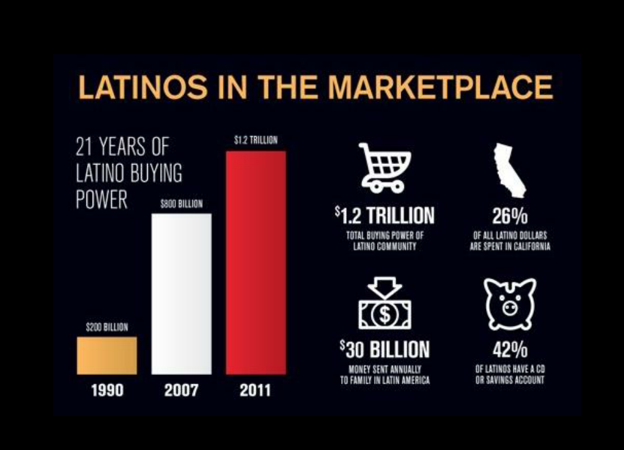
Screen Shot 2013-03-18 at 9.36.55 PMOver at Interactive, there were panels like the eerie wolf hunting sounding Latinos y Silver Mobile Bullet, and blatant corporate brand chasing Why Hispanics Love Toyota.  These panels were by and for marketing and media entrepreneurs looking to get that stack of paper from Latinos’ trillion dollar purchasing power market.   Boring old pies, graphs, stockpiles of data research were shared, all to figure out consumer habits, manipulate cultural customs and find ways to exploit and capitalize in reaching the elusive Latino market – reminded me of a laboratory with white coats searching for the formula.  Corporations are practically salivating at this young-skewing, smart phone mobile going, disposable income population (disposable if only because the income is not going towards accessible medical/insurance etc).  My immediate reaction is to question the sample data and how they are identifying Latino?  The census reports 53 million and Pew data further breaks down foreign and native born’s online presence.  What about the rising population of Latinos who are checking other on that outdated race and ethnicity form? It’s all convoluted to say the least.  The data might get all sophisticated and from a million different entry points, but the biggest flaw in the foundation is the label.  That said some of the more savvy marketing media are slowly coming around to acknowledging “Hispanics” are not a monolithic block.

Screen Shot 2013-03-18 at 9.51.02 PMToyota did exactly that with their mega successful 2010 ad campaign, Somos Muchos Latinos, Somos Muchos Toyotas, a now much lauded case study in which they took advantage of our loud and proud ties to our ancestors’ roots i.e, “We are Many Mexicans, We are Many Toyotas”.  They made the template and attracted Latino consumers to go online and order personalized decals according to their family’s origin. Going back to film  – I think  the missing ingredient in all of this research into figuring out who we are is supporting independent Latino films because they represent the authentic American mestizo culture.

I dropped by “The” Latino event at SXSW, The Social Revolución party, a Latino social media awards party.  The best part of it was the complimentary anejo mezcal.  The food was a joke and I wouldnt even mention it if the expectations had not been set high from the invites. Nopalitos (cactus) tostadas, chips and stuffed mushrooms – come on. I found out the real comida was in the VIP room.  Yes, there was a VIP room  – against everything that SXSW stands for.  I’m not trying to commit brown on brown hate, and really I don’t care that I wasn’t voted best Latina blogger 😉 But I have noticed in going to more of these strictly Latino affairs the tendency to over-celebrate everything and anything, takes precedent over  a strategic how to discussion of ways to develop our voices and agenda. I expected this kind of exchange here given its tagline.

I’m happy to have talked shop with some of my most esteemed professional amigas like Cristina Garza, the head of acquisitions of Canana and newly launched international sales company, Mundial.  Partnering up with IM Global, they will pick up 8-10 Latin American commercial movies.  Key word= commercial.  All anybody thinks of when it comes to Latin American films are the gorgeously shot art house slow burn dramas  – and there is an extraordinary canon of them, but there is a wave of emerging filmmakers who are making artful, resonant and more accessible films.  Mundial will represent Paraiso, the next film by Mariana Chenillo who became the first female to win Best Director at the Ariel Awards for her opera prima Five Days Without Nora.   I also caught up with Tonantzin Esparza who headed up acquisitions at her father’s company Maya Entertaiment for years before she moved to New York.  She is currently finishing  up her Masters at NYU and planning to get back into the game, in the film packaging agenting world so recruiters take note and holler at my girl.

ritz n bootsDEEP THOUGHTS
Going in I was going to write up a daily Festival dispatch but this kind of an immersive marathon makes it extremely difficult to stay sane, sober and fresh.  The advantage of looking back over the week, catching up with emails and looking at the biz cards I collected is making thematic connections.  Film is not an isolated medium, so much is a fluid, biochemical reaction and reflection of the world around us.

The only criticism I would give the fine folks of SXSW Film was a reverberating observation I made at the screenings.   I know as moderators we are suppose to stay within the time allotted for Q&As.  I do my best to defer to the theater managers so their team has time to turn over and make sure the next movie starts in time.   But I also know that I’ll risk their wrath if the audience is so enthralled with hearing the filmmaker confess his creative process, we are going to run a few minutes late for the next show.  I liked the programmers keeping the intros short and sweet to get the movie started right away.  If they said anything at all it was to remind us of the high volume of submissions they received so therefore this film was special for its inclusion.  I found the emphasizing on this unnecessary.  For comparison this year SXSW received 2,096 features – of that 1,482 US, and Sundance counted 4,044 features, of that 2,070 US.  When it wasn’t a core programmer introducing and moderating, the festival invited alumni filmmakers to do the honors which didn’t always work.  There is nothing better than someone on the programming team who has a connection to the film and filmmaker.  Obviously it is impossible for the small group of programmers to do all the presentations.  What about the screeners?  Chances are they would die for the chance to feel like a bigger part of the festivals.

That said, in the grand scheme of things this is minor stuff but I wouldn’t be real if I had nothing but good things to say about a festival which is a living and breathing organism that can always be optimized.

Thanks for the memories South by Southwest.    To cap it all off, I’d like to quote from the hedonistic, blazing, neon flash, glorified American wet dream by Harmony Korine who brought another kind of D2F (not Direct 2 Fan) to SXSW with the US premiere of Spring Breakers.

“We came down here to find ourselves….. Spring Break for eva bitches!”

Spring break 4-EVA.

SXSW 2013 – Raves, Reviews and Rants (Recap Pt. 1)

Screen Shot 2013-03-16 at 11.03.01 AM

THE SCENE AND PEEPS
Starting with their signature pre-screening violent yet comical threats to the audience to shut the hell up and power down during the movies, the hilarious, non-sequitur trailer bumpers (to celebrate 20 years, a slew of previous years’ bumpers were shown), the invaluable taco graphic map resource (thanks Taco Journalism!) to the climactic progression of the downtown block party vibe as Interactive and Film gets tossed aside to make way for the festival’s explosive origin: Music, SXSW inhabits a radical American cultural vortex among international festivals. Needless to say, I had a blast this year, even if I didn’t stick around to get destroyed by the Music.


20130310_003531#1
Loves Her Gun Q&A
Director, Geoff Marslett and his actors Trieste Kelly Dunn and Francisco Barreiro

What I love here is the real and casual film junkie vibe (without the Telluride Film Festival pretense). It’s easier to have meaningful conversations with filmmakers over free libations in a crowded happening party.  I’m so happy I got that chance to do just that with David Wilson about his excellent Branson doc, We Always Lie to Strangers, and Lauren Modery and Geoff Marslett about their Brooklyn-Austin odyssey, Loves Her Gun.  Both films took home jury honors at the end of the week; Special Jury Prize for Directing to AJ Schnack and David Wilson, and the Lone Star Award, named after Louis Black, Austin’s stalwart king of the Arts – editor of Austin Chronicle and SXSW co-founder. It was awesome to catch up with the multi-media artist/advocate/revolutionary  Ondi Timoner (Dig!, We Live in Public) who was there on the jury, doing her awesome doc interview show, BYOD and promoting A Total Disruption, a wildly innovative and online community to guide young startups and inventors. Does this woman sleep?

Screen Shot 2013-03-17 at 12.56.37 PMOf the cool new people I met and connected with was Emily Best, the enthusiastic no nonsense founder of crowdsourcing/building/distribution platform Seed & Spark. Taking it one step further in capitalizing the public’s desire to be part of the filmmaking process, Emily has found a way for potential funders to take away ‘stories’ from their contributions.  Like a wedding registry, you can donate for certain items.  We both agreed the concept of ‘windows’ should be killed, or at least restructured (referring to the confined first theatrical, then dvd then online life of a film).  Indeed, for all the social media buzz and rave reviews that will whet the public’s appetite and craving to see the films that premiered at SXSW last week, the public won’t be able to see them for at least another six months.  You can argue this essentially squashes that high awareness apex and momentum in its tracks.  Why wouldn’t a filmmaker slap their film online after a great festival premiere?  Because as the archaic model stands, it means no more exhibition or traditional print publicity opportunities – no more festivals, theatrical distribution, forget about that pipeline dream of Oscar qualifying run.  I certainly don’t have the background or numbers to make the grand argument of which scenario would bring the filmmaker more money in the end – but I would venture to say that monetizing immediate online access of your film post- a high profile festival like SXSW is certainly a viable way to sustain your filmmaking.  Vision = brand.

The stimulation overload at South By is perhaps akin to stumbling wasted into the Circus Circus casino in Vegas, but instead of sucking your mojo dry, here it seeps and fuses into your brain igniting new tech and film (and life) ideas.  I certainly came away with lots of new opportunities and ideas I’m excited to put into action.   This kind of festival is well worth the full 10 days-if you can handle it.  I did 8 days and had to take one of them off.  I had hoped to do more Interactive stuff but I have to admit Interactive intimidates me.  I step onto the trade show floor and half expect to walk into a Teleporting Beta simulation gone wrong.  But as evidence I tried, my very first happy hour I went to after getting my badge was Startup Village at the Hilton.  There I ran into Todd Berger who was giddy at having his SXSW virginity popped.  He co-stars in the Narrative Spotlight SXSW selection Good Night with Alex Karpovsky and Jonny Mars, directed by Sean H. A. Gallagher.  Berger is also representing 99 Tigers, a creative commercial outfit.  But most importantly, he is peddling his delightful relationship comedy/ Apocalypse Sunday brunch film, It’s a Disaster, currently available on iTunes.  Starring America Ferrara, David Cross, Julia Stiles, it’s to die for.  Recommend.

20130314_213209
Milo by Jacob Vaughan starring Ken Marino who is plagued by a demon in his colon was the best movie to close out my festival Thurs night. So outrageous, hilarious and quite heartwarming.

 MOTION PICTURE RECAP – SXSW IS THE NEW HOT DOCS

(Click on hyperlinked films for my thoughts/reviews). It was a pretty damn good program so it is hard to single out a top five.  Out of the 20 new movies I saw at the Festival, the ones that stood out the most for me were rockabilly music label documentary, Los Wild Ones directed by Elise Solomon, We Always Lie to Strangers, Loves Her Gun, the Harry Dean Stanton documentary, Partly Fiction and Short Term 12 set in a mental juvy home about troubled adolescents and the troubled adults that care for them.  Destin Daniel Cretton’s second feature ended up winning both Jury and Audience Awards.  I’m not including anything from Sundance or the handful of films I saw in consideration for Sundance which premiered at SXSW.  And I’m not done covering SXSW either.  Thanks to Festival Scope, I’ll get a chance to see more of the films I missed. For 70 euros/year (I think thats about 100 bucks) you can sign up  – if you are some kind of film professional – and watch a selection of movies from most of the big international film festivals.  It’s an invaluable resource for film programmers.

62778_465562743516914_1998440440_n
Dennis Creamer, Ty Martin and Robert the “Mouth” pic the three souls of Before You Know It – pic courtesy of FB page

I had not previously thought of SXSW as a strong doc kind of space, outside the typical music docs of course which are plentiful.  However I found myself being pulled into more documentary screenings and looking at my list, I loved more of the docs than fiction features. For instance, PJ Raval’s sensitive doc, Before you Know It, which follows three main elderly gay characters who you can’t help become utterly endeared to, moved me to tears and joy in witnessing their unconquerable spirit.  The Act of Killing, a film about Indonesian paramilitary killers reenacting their crimes as Hollywood films which I’ve wanted to see since its Toronto International Film Festival debut. It was as disturbing as the hype that precedes it.  Los Wild Ones, We Always Lie to Strangers and Partly Fiction I already mentioned  – all speak to how the Festival has applied their edgy, offbeat artist sensibility to the makeup of the doc program.  I couldn’t help notice however that two fantastic upcoming docs did NOT make their world premieres here.  They  are the highly anticipated performance protest punk band profile of Devo, Are We Not Men, and the cinephile’s wet dream of the almost glorious consummation of the heralded 1965 sci-fi novel, Dune and cult auteur Chilean director, Alejandro Jodorowsky (Santa Sangre is my all time favorite movie EVER).  Take a look at the trailer and background on Jodorowsky’s Dune here on Geeks of Doom.   I gave this heads up tip to Martijn te Pas, the IDFA programmer I met in the panelist green room.   IDFA, the International Documentary Film Festival in Amsterdam is THE most colossal and important festival for documentaries.  This kind of info is currency and credibility in my network.   Another sign that SXSW’s doc star is rising was the fact that my lovely friend and longtime programmer at Morelia Film Festival,  Mara Fortes was there scouting docs for Ambulante, the traveling documentary film festival in Mexico founded by Diego Luna and Gael Garcia Bernal (Mara’s twin sister Elena Fortes is the Executive Director). We went to a few screenings together and she gave me the latest Ambulante Program catalog –  the first one in which I’m officially credited as Programming Correspondent (yay!).  A couple films I am sad to have missed because I heard great things from trusted sources were Baltimore biking gang doc, 12 0’Clock Boys, and The Punk Singer  – about Bikini Kill and Le Tigre’s Kathleen Hanna.   For much more insightful and broader coverage of the festival’s documentaries go to my  dear colleague Basil Tsiokos’s website, What not to Doc.

PANELS AND CONVOS
One of my panel highlights was actually a panel I was asked to participate in. Joe Beyer, Director, Digital Initiatives at Sundance asked me to  join him in speaking to the class of Carnegie Mellon’s Master of Entertainment Industry Management, a very intrepid two year intensive class and field program geared towards aspiring producers and engineers in the film industry.  Part of their curriculum includes ‘field trips’ to Sundance, SXSW and even Cannes.   It was so exhilerating to see such ambitious and smart young men and women.  I was particularly pleased to see a balanced group of women and men of color in the room (what the hell happens later in the workforce!!?).   I encouraged folks to carve themselves out a specialty, giving as an example my own work as Latino film expert.  Both Joe and I evoked our old boss Geoff Gilmore’s philosophy of articulating the POSITIVE merits of a film.  Anyone can talk shit about a movie’s logline, characters and production value.  Maybe they think its cooler to do so.  It’s definitely a unique trait I’ve learned at Sundance; to always identify and celebrate the positive aspects of a filmmaker’s vision.  Everywhere else seems to start with the negative first.

20130309_133652
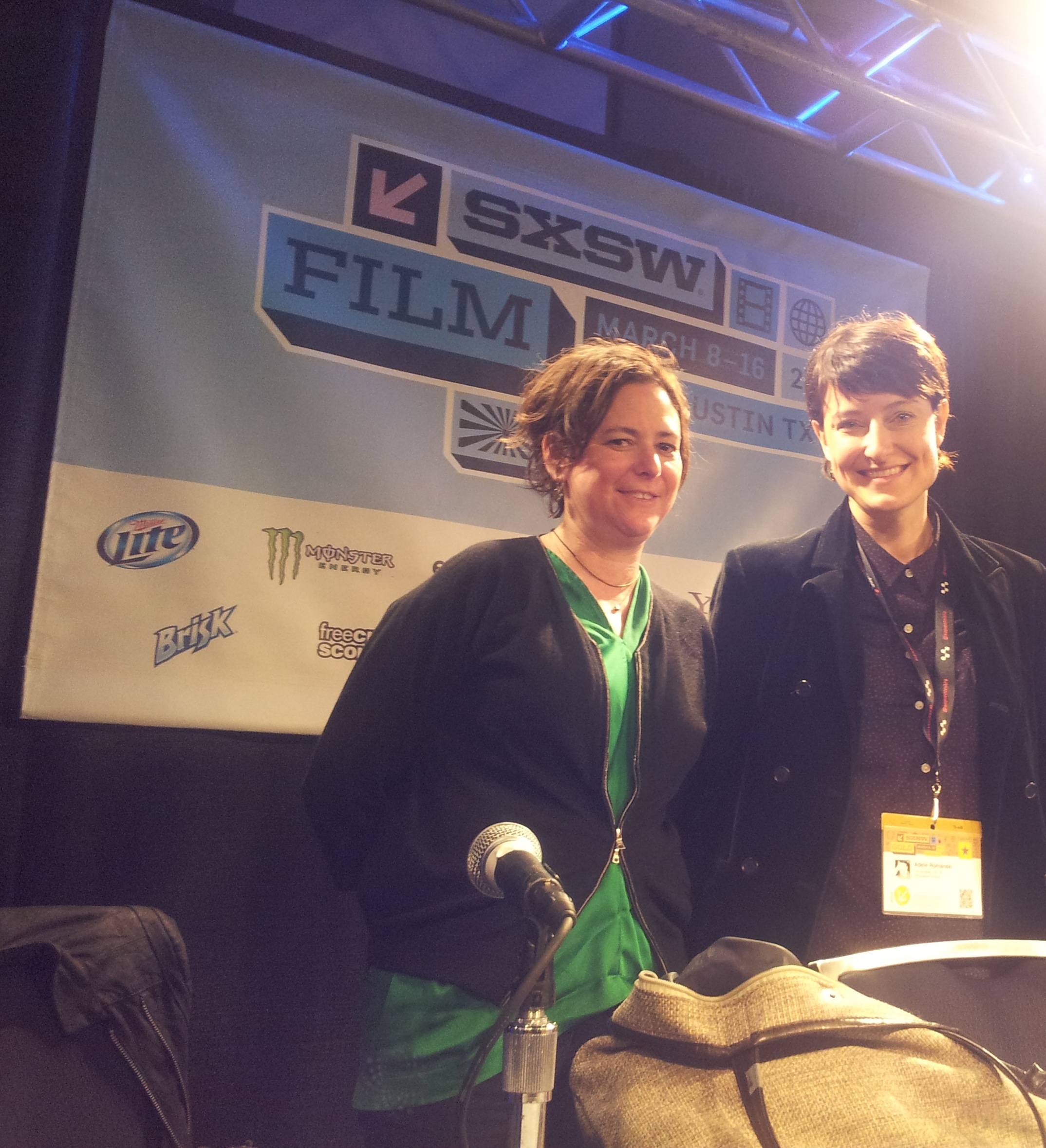
Studio vs Indie Producers Panel with Lisa Muskat (Prince Avalanche, All the Real Girls George Washington), and Adele (pronounced A-dey-la) Romanski (Milo, Black Rock, Freebie)

I  went to Studio + Independent Producing panel in which Lisa Muskat, Adele Romanski and Scott Mosier exchanged horrible and hilarious situations faced while working with and outside the studio system.  50% of being a producer is about the relationships, Adele said.  Mosier, who has produced most if not all of Kevin Smith’s movies pointed out that with studios, you are well aware you have a product, it is coming out, there is a release date, print and advertising but all of that comes at a creative price which influences your creative work.  He remembered being shocked that a studio executive told him it’s not just about making movies with your friends (um, yes it is).  They all chimed in about the ridiculousness of test screenings which seem as if they are purposely there to get slammed.  On the other hand, Adele argued she’s felt that when screening in front of friends her concern is that they might hold back on criticism.  I also went to Not So Short Story: panel with Calvin Lee Reeder (Rambler), Hannah Fidell (A Teacher) and initially I did not recognize the guy whose last name was Henry but when he talked about his film as “the gay bathroom gang rape comedy”, I immediately knew that must be Kyle Henry director of the short film trilogy Fourplay. All three had great nuggets of wisdom when it comes to expanding your short into a feature and about playing the Festival circuit.

For my own mentor sessions on Sunday I had the pleasure of meeting with Christina B who with a group of her peers founded and writes for this awesome How to Break into the Film business blog called Indies Unchained.  She’s volunteered at Sundance and now SXSW and is getting out there as a filmmaker and working towards a career as film festival programmer. I also met a passionate documentary directing duo, Ahbra Perry and Taylor Higgins who have been working on their film Power of Pearl for the last three years.  They had thoughtful questions, I was definitely intrigued by the macro and micro exploration of the world’s only living gem.  I felt they were on the right track by taking the time out to watch other docs and taking advantage of the networking and mentor sessions the festival offers.  Unfortunately not every meeting or networking introduction sparks a great connect.   As a matter of fact, I do have an idea for a panel (or bumper) next year. It’d be geared towards the ‘professionals, filmmakers and panelists who will inevitably get cornered by a bright (crazy) eyed enthusiastic newbie ____ who wants to know if you would ___their ____ or if it has a shot of ___.   Oh, by the way, the ___ in question has absolutely no rhyme or reason, and next to no potential.  How do you not come off like a jerk?  Start with the positive kids.   We like weird.  But it’s gotta be calibrated effectively.

Pt. 2, parties, shenanigans and deep thoughts

Recommend: Gun Hill Road

Recommend: Gun Hill Road

Thanks to this exclusive from Indiewire commenting on the precarious state indie films are left when their distributor goes bankrupt, for bringing to attention that one such film, Gun Hill Road, written and directed by Rashaad Ernesto Green has managed to overcome this unforeseen temporary roadblock and is now available on Netflix.  Co-starring Esai Morales and Judy Reyes, Gun Hill Road is a fierce and sensitive NYC coming of age trans drama buoyed by its break out star Harmony Santana.  The authentic and fresh way the film deals with an identity crux of a gender variant teen clashing with the father’s traditional Latino masculinity (machismo) is a triumph for the rarely represented Latino LGBT voice.  Put it on the top of you instant queue ahorita!

p.s. regarding the Indiewire piece, word on the street is that Filly Brown which was recently dumped by Indomina Releasing has been picked up by Lionsgate, but this girl has been unable to confirm.

CineFestival 2013 recap – San Antonio’s West Side Joya

IMG_2469
Lou Diamond Philips, Patty Ortiz, directof of Guadalupe Cultural Arts Center, Godfather Jesse Borrego and Gina Rodriguez pre-screening

The 35th CineFestival drew to a close Saturday night with a jam packed screening of Filly Brown attended by its filmmakers Amir de Lara, Michael D. Olmos and actors’,  Gina Rodriguez and Lou Diamond Philips.   At the Q&A, a charming Lou Diamond serenaded the audience with an impromptu rendition of La Bamba, in commemoration of the 25th anniversary of the seminal chicano rock film, and Gina aka Filly rocked the mike herself, demonstrating she’s got the rap skills down cold.  Afterwards, filmmakers, friends and staff walked across the street to la Casita,the festival’s lounge that is a cute house with a huge Ice House backyard with benches and fire pits, fully stocked free Indio beer, (a nice break from the usual fest sponsor Stella), delicious sausage in tortillas and a rockin girl DJ spinning classic vinyl.

missionparkboys
Mission Park boys – Julio Cesar Cedillo, Jesse Borrego, Will Rothhar, Bryan Ramirez, Douglas Spain, David Philips and Jeremy Ray Valdez
Photo courtesy of Cedillo

All in all, it was a fun week of meeting young emerging filmmakers and getting to know the relatively nascent San Antonio film scene.  It all started with Opening Night film, Mission Park, a film that was shot in San Antonio by native filmmaker Bryan Ramirez.  The people came out in droves to see this home grown film – so much that there was demand for a second screening.  It was a lovefest at the screening Q&A which was attended by the producers, Douglas Spain, Armando Montelongo (Flip this House real life real estate tycoon), and cast, Jeremy Ray Valdez, Will Rothhar, Julio Cesar Cedillo and David J. Phillips (also producer).  Bryan Ramirez spoke about meeting Douglas Spain at CineFestival a few years ago and giving him the script back then which is how the Star Maps actor came on board as producer.

After the film I tagged along with the crew to Brooklynite, a fancy chic parlor mixologist bar – the type you’d find in hipster Venice or WeHo.  There I met and  talked with Jesse Salmeron, a filmmaker from the bay area whose first feature, Dreamer is world premiering at CineQuest.  Jeremy Ray Valdez produces and star’s as the film’s lead, Joe Rodriguez, a well educated young man who is unable to get ahead in life because of the lingering fear that he might be deported.  Demonstrating a strong visual approach within a timely, compassionate story, I just added Jesse to my hot Latino writer/directors to watch out for.

ALAMO CITY FILMMAKERS & THE FILM SCENE

San Antonio Film CommissionAmong the bourgeoning SA filmmakers are Bryan Ramirez, Kerry Valderama, Bryan Ortiz (all three collaborated on the asylum anthology film Sanitarium with Malcolm McDowell), short filmmaker and beloved highschool film teacher, Sam Lerma, Steve Acevedo who directed the short film El Cocodrilo, a powerful story starring Jacob Vargas as a reporter on the run from narcos, Ralph Lopez, producer of Wolf which premiered at SXSW last year, Ray Santisteban, award winning documentarian who won Best doc short for the six minute Have You Seen Marie, a slice of celebrated Chicana author Sandra Cisneros’s new book.  And if there were to be a Godfather to this crew coming up it is San Antonio’s querido, artist/activist/actor, Jesse Borrego (Mi Vida Loca) who moved back to to his hometown last year after spending 15 years in LA.  I think he is the most generous, warm hearted and enthusiastic patron saint of the Guadalupe community.

So where my SA sisters at???  Well there are a lot more females working within the documentary medium.   Filmmakers like Laura Varela whose films rescue forgotten  American Latino heroes, Deborah S. Esquinazi, the director of The Recantation, a work in progress documentary about four Latina lesbians wrongfully accused of molestation, and Lindsey Villareal, whose short doc about a Mariachi family in East LA, Canto de Familia,was super moving in an enjoyable and Mexican pride way.  She is currently attending USC’s MFA Film Production program.  Another female documentarian I was impressed with is Angela Walley who with her husband Mark made this extraordinary doc profile short, Vincent Valdez, Excerpts for John.  Watch the full short here.  

Drew Mayer-Oakes, Director of the San Antonio Film Commission told me about the matching grant available to local filmmakers which launched just last year.  Blessed by Julian Castro, the $25,000 grant will support local filmmakers who have at least $25,000 in funding commitments in place for a feature-length motion picture.  Family movie Champion by Kevin Nations and Robin Nations, is the first to have been awarded the grant last year out of 8 applications. The program is funded and managed by the City of San Antonio Department for Culture & Creative Development (DCCD). The program is a collaboration with the San Antonio Film Commission, a division of the Convention & Visitors Bureau.  This is but just one of the programs and resources Drew is putting together to ignite the local filmmaking scene

THE NEXT GENERATION

IMG_1738
Winner of the highschool short film showcase, Nicolas Rodriguez for his film, The Exterminator.

The festival is instrumental in providing access, inspiration and platforms for aspiring filmmakers.  I had been looking forward to Monday’s Youth Film showcase,  a program of local highschool shorts, and it did not disappoint. Taking home two awards, Best Narrative and Emerging Filmmaker was Nicolas Rodriguez from Harlandale High, the director of the wacky and original comedy called The Exterminator.   Upon accepting his award, he mentioned he looked up to filmmakers like Robert Rodriguez and Guillermo del Toro.  I was also impressed with videographer/artist Daniela Riojas, who was working as the Festival’s official photographer and is a radical artist and performer who screened her music video Pop Physique in the shorts program.  Check out her work  here.  I also got to meet Efrain-Abran Gutierrez, son of  the pioneering filmmaker who made the very first Chicano film right here in San Antonio, Efrain Gutierrez (Please Don’t Bury Me Alive).  Efrain Junior founded his own production company, Landmine Entertainment where he does everything from discovering and shooting underground hip hop music artists to currently developing a couple documentaries on forgotten Chicano activists.

I haven’t talked about The Crumbles on this blog yet so I want to give it a shout now as its become one of my favorites pieces of fresh and microbudget fimmaking; The Echo Park set slacker film completely captures the multi-culti indie hipster artist hood in an affecting way by focusing on the young persistent indie rock movement and spirit, come hell or high water. I loved the Latina rocker lead played by El Teatro Campesino performer Katie Hipoland the music (soundtrack by Grammy winner Quetzal).  The director Akira Boch raised 10k on Kickstarter to take it out on the road himself and he’s out there doing it now.  Check here for a list of the film’s DIY screening engagements.

THE SUNDANCE SUPPORT

Wednesday kicked off the first ever CineFestival Latino Writers Project lab, a collaboration with Sundance Institute’s Feature Film Program.  The four writers selected to participate met with filmmaker and creative advisors, Nancy Savoca (who made one of my all time favorite h.s. movies True Love), David Riker (The Girl) Cruz Angeles whas was the co-creator of the Latino Screenwriters Lab (Don’t Let me Drown), Mauricio Zacharias (co-writer of Keep the Lights On) and Hannah Weyer (Life Support, and novelist of upcoming book, On the Come Up).  I wish I had had  a chance to really talk with the screenwriters but they were too busy and immersed with their mentors.   I did hear that they found the workshop and advisors incredibly valuable, and their only wish was that they had more time with them.  It sounds like most of the advisors offered to stay in touch with them and make themselves available throughout their creative process ahead.  Out of the four writers only Miguel Alvarez is from around these parts.  Miguel is a well known filmmaker and trusty collaborator here in Austin whose fantastic project, La Perdida plays like an Eternal Sunshine meets Seven Monkeys set in Mexico City.

20130302_124011
Ilyse McKimmie, Cruz Angeles, David Riker, Nancy Savoca and Richard Guay

On Saturday morning the enlightening Sundance panel, Essential Elements: Making your Vision a Reality, was moderated by Ilyse McKimmie, an incredibly generous and erudite creative guru.   The conversations and questions ranged from, at what point does a writer share their working draft, to what is the next step after final draft, and a large discussion about how critical it is to find the right creative producer.

There were a number of interesting new filmmakers I had the pleasure of meeting like immigration lawyer and documentarian Sarah MacPherson whose Stable Life, a glimpse inside the undocumented immigrants who work and live in horse race tracks won the Documentary Prize.  It was also nice to hang with filmmakers I’ve met before like David Riker.  There was a good turnout for his film and a very affected audience afterwards at the Q&A. The Girl is being released by Brainstorm Media and The Film Collective, a new consulting company headed by Ruth Vitale, former head of Paramount Classics.  This exciting and new partnership previously theatrically released Todd Solondz last film, the Ted Hope produced, Dark Horse.  For a list of theater venues and times to see The Girl (LA/NY/Chicago/Phoenix/San Antonio and San Diego check here.

Like I reported here last year, CineFestival is such a rich and nuclear community festival that reflects the unique spectrum of its inhabitants and neighbors.  There is a high level of chicano consciousness alive and well that is inspiring this young generation to tell their stories.  San Antonio is becoming a really happening artist haven and this edition of CineFestival made important steps towards developing and tapping into this artistic filmic pulse.  I hope to continue collaborating with this festival in the future and I want to thank the formidable organization, Patty Ortiz, Executive Director of Guadalupe Cultural Arts Center, Jim Mendiola, Festival Director, Yvonne Montoya, Program Director of Guadalupe Cultural Arts Center and Orlando Bolanos, Education Director.  Gracias por todo y hasta luego!

Lessons from La Lupe

Since Sunday night’s Oscar telecast the interwebs have exploded with fury about the omission of Lupe Ontiveros in the Academy’s In Memoriam segment. I didn’t think to add my 2 cents until right now because frankly I wasn’t surprised at all. But now I got something I think worth sharing. I was combing through my computer for some video and I ran into this clip I took of the late great Lupe at last year’s NALIP where she delivered a moving speech in her irresistible, witty, loving spicy way to bestow the Lifetime Achievement Award to Rita Moreno. You know what I get out of this? It’s our responsibility and ours alone to value and recognize our people. Are we really so appalled and shocked that the Academy denied her membership? What good is it to ask the Academy to explain and question their commitment to Latinos? I suppose it could be looked as a tongue in cheek PR move because clearly that is not on their list of To Do’s, let alone their sensibility. What really gets me is that it seems like we are seeking validation from an elite society of homogenized, old white males, half of them retirees. I believe the significance of the Academy Award is more an antiquated status symbol, a vestige of show business like the stars in my neighborhood’s Hollywood Walk of Fame, than a recognition of achievement.

If this incident serves to fuel and spill our community’s amor and tribute to La Dona Lupe’s legacy, that is indeed a positive. But hear her words in this clip. How she shares her sincere admiration, love and respect for Rita Moreno. It makes me think, its more beautiful, powerful and honest when we ourselves elevate and commend our mentors, peers and younger generation. Another key observation in this clip;  Notice Lupe calling out Ms. Moreno by way of inviting her to be part of NALIP, essentially pointing out that this highest Entertainment Awarded Puerto Rican woman, is not part of the National Association of Latino Producers, a grassroots organization which struggles but continues to support a young crop of filmmakers with labs, workshops and development opportunities. “Show up once a year”, Lupe says. ” We need figures like you.”

Goes to show that there are members of the Academy who are brown. I take more issue with the Hollywood Latinos who having personally faced and overcome barriers and stereotypes, yet once on the inside, don’t take the obligation or responsibility seriously as self identified Latinos, to keep the gates open.

Interview with Alex Rivera – to the infinite Sleep Dealer and Beyond

riverapic1Inquiring minds want to know, what has the Peruvian-American multi-media artist and filmmaker of the radical film Sleep Dealer been up to since he broke through at the 2008 Sundance Film Festival.  I had a chance to catch up with Alex and find out what’s shaking.

Sleep Dealer had been percolating through development for a few years when it participated in the 2001 Sundance Institute Screenwriters lab.  It premiered in the festival’s US Dramatic Competition in 2008 where it was bestowed with the Waldo Screenwriting Award for Alex and his co-writer David Riker.  The ambitious and thoughtful genre bender (eco/romance/sci-fi/adventure/socio-political thriller), was a uniquely original feature debut which earned him lots of buzz including a spot on Variety’s Ten Directors to Watch. On the heels of all the Sundance momentum, Alex was courted around town for various projects, mostly speculative script work (aka free labor).  One of the projects he became attached to write and direct was a film based on the Wired article “La Vida Robot,” then being produced by Salma Hayek and John Wells.  Meanwhile, Sleep Dealer was released by Maya Entertainment in April 2009. Unfortunately, Maya’s theatrical releases struggled to make much profit (the company quietly shuttered last year to dissolve its debt). Sleep Dealer averaged 2k in its 18 booked theaters NY/LA  Opening Weekend engagement. My opinion?  Lack of a strong and savvy marketing campaign along with Maya’s model of booking the film at its out of the way fringe theater markets hurt the film’s shot at targeting the audience it eventually found elsewhere.  And where it did find a cultish nerd-like audience was in the educational space.  Alex has traveled to over 50 campuses and continues to do so in order to discuss and engage with the complex layers and themes the film generates – a testament to the heavily research based scientific, sociological and immigration alchemy of the film.   Let’s check in, shall we?  {redacted transcription of our recorded conversation}.

sundanceWhat are some of the exciting things you’ve worked on immediately after Sleep Dealer?  

David Riker and I developed a TV series.  It’s called “Blink!” It’s about a woman who suffers a strange accident, loses her eyesight, and is given digital retinas, a technology that is currently being developed.  Shortly after she starts to see again, she realizes something is terribly wrong – her head is transmitting.  You can see what she sees through a live video feed.  She doesn’t know if her eyes are malfunctioning, if she’s been ‘hacked,’ etc.  The show follows Blink as she tries to unravel what’s inside her head and the possibility that she is part of a conspiracy that might even be altering her reality.   We still have the material and are looking for a partner for it, we’ve had different partners along the way.

One of the more surprising developments for me was an ongoing collaboration with the community of activists working around the cause of immigration.  The National Day Laborer Organizing Network became aware of my work through Sleep Dealer.  They are really active working with day laborers in this grassroots way, but they also have a unique cultural strategy.  They happened to be in touch with Manu Chao, the legendary and popular World music artist, who in his work sings about the experience of migration. They put me in touch with him and we produced a video in Arizona. We did the same thing with Ana Tijoux, a Latin Hip Hop artist, and we are dialoging with other artists like Zack de Rocha and La Santa Cecilia, a local LA group Latino music mashup group.  It’s been deeply fulfilling not going through agencies but rather activists that are committed to the same values that I am committed to.  So that kind of has been my reality; partly working with these activist groups on these cultural projects, partly shopping around ideas in this system like the Sci-Fi TV series, and partly supporting Sleep Dealers’s after life.

You also work with other filmmakers on an ongoing basis, talk about your collective:  

 Screen Shot 2013-02-27 at 10.07.05 AMI’ve been working with other filmmakers for the past 14 years through a small distribution company called SubCine, like subliminal, subliminated.  The idea behind the name is that experimental films, documentaries and risky fiction films are already shut out of the mainstream film culture, so then if you are making that kind of work from the Latino perspective its yet another level of marginalization.  Its like we are the outsiders of the outsiders.  It’s an exciting place to be, to think, imagine and attack from.  We are a small collective of filmmakers like myself, Jim Mendiola Gregorio Rocha, Jesse Lerner, Cristina Ibarra, Natalia Almada, Dolissa Medina.   A lot of us were making our films in the 90s and selling our films individually.  We decided that instead of selling them individually, to compile a catalog together.  From one day to the next, a distributor was born.  We have a warehouse that keeps the films, does all the fulfillment and billing so we don’t have to lick the stamps anymore. Most traditional distributors pay filmmakers 40% minus expenses.  We pay 70% with no expenses taken out of that.   We are a very slender operation but set up to make the sales and get the money to the filmmakers. Right now we have almost 50 films in the catalog and over 20 filmmakers that we work with.  I manage that on a month to month basis as one of my many other side projects.  It’s been super fulfilling because its getting the films seen. They are sold to only a little segment; the libraries, universities and colleges to be used in classroom.   Those institutions will pay $300 more or less for a DVD because they are using it in the institutional context. Then that work is seen by young people hungry to learn, whose ideas about the world and ideas about film are being shaped, so its a win-win-win.

That’s an interesting model, you think there is room for more of these kind of distribution platforms for Latino filmmakers?

We were inspired by New Day Films, a social issue documentary distribution collective. It’s a lot of the same thought; Lets not work alone, lets work together.  If you sell your film maybe the person who bought it would want to buy my film. It’s like this collective spirit of a distributor that’s owned by the filmmakers.  The educational market doesn’t sound glamorous, but it’s absolutely essential for students to see the wide variety of films and it gets to them when their brains are soft and squishy and malleable.  It’s an influential moment to reach that audience.  And they still pay – librarians still care about getting a licensed copy of a film for their collection and are willing to pay for it.  In a day and age when nobody seems to get paid, this market is a unique space to be.

With all these side projects and day to day busy-ness and constant fellow filmmaker collaboration and stimulation how do you concentrate on developing your own projects and tell us what personal project are you focusing on now?

File photo of Ries Lopez Tijerina
Reies Lopez Tijerina

I have a curious mind and active imagination, which is a curse and a blessing.   Definitely over the years I have had many ideas and I try to do everything I just mentioned plus develop my own material.  About a year ago I got interested in the story of a legendary Chicano activist – somebody who should be as well known as Martin Luther King, Malcolm X or Cesar Chavez but who is not.  His name is Reies López Tijerina.  He led an armed movement in New Mexico to reclaim part of the land for the original Mexican families that had settled there before it was the United States – the land that was stolen after the war with Mexico. Tijerina is a fascinating character and there are parts of his story that are like a Quentin Tarantino film. Like he would wear a suit in the desert while armed, trying to arrest police officers….it has that kind of great genre and humor in it, but it also taps into extraordinary realities and histories about The Southwest which have, for the most part, been forgotten.

How much does the general public know about this man?

I think the general public knows close to nothing. People who study Chicano history would run into his story but not everybody even in that category…We live in a strange age where there are 53 million Latinos in this country and yet if you ask, ‘Who are some great Latino figures in U.S. history?’ most folks can’t name five.  Whether it’s the result of a concerted effort or not, the history is missing.  I mean, you look at Arizona and they are banning books about Chicano history, you start to think maybe it is concerted.  Either way, you don’t get 50 million people here overnight.  There’s a long history that has been erased and its part of the duty of artists who define themselves as Latino to rescue parts of that history because we deserve to know it.  Tijerina is one of those incendiary, wild and fantastic stories and there should be many films about it and yet it is exactly the opposite.  He’s nearly completely forgotten and he’s not the only one, there is a whole series of these kind of figures that have been swept under the rug.  It’s a problem and also an opportunity because it is definitely time now to think of ways that are visually exciting to tell these stories.  When I talk about history, it’s not to put someone to sleep, its not a Ken Burns treatment. This is life and death, sex, people fighting over billions of dollars that are at stake, the future of the country  – these are high stakes, thrilling stories going back to days of the Conquest up until today.

How would you go about rescuing these histories and making it modern, relevant and accessible in order to capture people’s interest in unknown historical figures?

 All the way through, if you look at any chapter in Latino history, and as I would define it, it starts with the conquest when the Spanish meet Native Americans and start to kill each other and enslave each other and make babies together and create a whole new race  -is there anything more Shakespearean? More dramatic?   No.  Obviously Mel Gibson took a stab at that time period with Apocalpyto, which was wildly successful commercially.  Why? Because he used a kind of genre approach.  It’s not a historical film, it’s an action film. Now I didn’t love the film but I can respect that it’s a piece of pop culture that is also telling a part of history.  Do I love its point of view? No.  But I respect the craft.  And so starting with that going up to, anywhere you drop the needle on Latino history there is something equally dramatic going on..…In the US Mexico war countless moments and characters and stories could be told through the genre of a heightened western that would be incredible.  Quentin Tarantino has just shown that films that are set in historical contexts but that us the energy and aesthetics of genre filmmaking can be wildly successful.  So the approach needs to be creative, elevated, the approach needs to push the envelope.  You can mine these histories for all kinds of fantastic narratives.  And, of course, the future can be mined as well.

**********

Thank you Alex for sharing!  Suerte compa!

National Hispanic Media Coalition 16th Impact Awards dispatch –

NHMCLast Friday night I showed up at the infamous Reg Bev Wilsh (if you don’t get the abbreviation the moniker has been embedded in my head by Laura San Giacomo in Pretty Woman) to cover the National HIspanic Media Coalition’s 16th Annual Impact Awards – a celebration of the positive portrayals of Latinos in media.

I meet Jose, the press liaison who shows me to a tiny spot on the step and repeat row with a piece of paper that says Chicana from Chicago on it.  I notice I’m right next to US Weekly – which I quickly decide is a strategic spot to seize all the juicy interview leftovers. I realize how little television I see as I don’t recognize any of the TV stars, Aimee Garcia, Morena Baccarin (Homeland), Gina Torres (Suits) and Lana Parilla (Once Upon a Time) so I don’t bother trying to talk to them. I did however got a chance to talk to loud, brown and proud multi-hyphenate John Leguizamo and writer/producer/playwright Josefina Lopez. I failed at grabbing the hottie Mario Lopez who showed up late but there’s an excerpt of his remarks below (the video I took is crap), and Michael Pena was a no show for the press line.

patty
Patricia Rae – Colombian New Yorker whose next acting role is in The Big Wedding coming out in April

After the arrivals I naturally assumed all press was invited to enter the actual Awards ceremony but lo and behold I found out that no, press were not invited to stay.  Looking around at the staff I recognized a lot of familiar faces from the usual Latino events and decided to ask politely and point blank if I could please go.  After speaking to three press staff, I was told they had no authority and that further there was no room. I always find these type of situations uncomfortable – mostly because I have been on the ‘bouncer list’ side for so long and I know that being on the list means nothing; it is recognizing who needs to be there and how you need to fill the place which means everything.  Taking the hint that press had to leave, the media room began to disassemble.  Observing that staffers were too distracted drinking the Moet sponsored Champ and taking pics in front of the step and repeat, I took a chance and literally snuck in behind the scenes like I owned it.  Once in the ballroom I found that there was plenty of room, and see acouple familiar faces like Bel Hernandez, publisher of Latin Heat, and actress Patricia Rae and writer/director Matteo Ribaudo.  Patty, Matteo and I took in the complimentary champagne and talked about our related experiences and upbringing growing up as a first generation from immigrants. Patty is Colombian by way of New York and like me learned Spanish first and had parents who talked about our related experiences and upbringing growing up as a first generation from immigrants. Patty is Colombian by way of New York and like me learned Spanish first and had parents who felt pressured to assimilate. During our exchange I realized that this can be turned into a positive impact on our lives; the fact that our parents witheld such an obvious part of our culture only fueled our desire to commune with it.  It is more special when you seek your origins from our own accord and desire.  Patty mentioned how she had to ask her abuela for the traditional Colombian dish, Sancocho recipe.   Patty is a very talented actress by the way. She blows away her counterparts in the indie movies I have seen her.  I’m glad someone is taking notice as she is the only Latina in the ensemble cast of Big Wedding coming out April.  The cast includes Robert DeNiro, Robin Williams, Diane Keaton, Susan Sarandon.  I have no doubt she carries her own with these big shots.    Her husband Matteo is currently writing a script with her as the Scarface/Godfather lead.  What I found interesting on his take on the classic gangster genre  was how he is deliberately approaching and utilizing the female psyche to explore power and how different violence perpetuated by women looks like.

mariolopezI stuck around for a couple Awards speeches.  I had no idea how much Mario Lopez identifies with his Mexican roots.  He thanked and appreciated La Raza for the award and told us about his childhood growing up in Chula Vista.  He is undoubtedly a super charming mama- done-raised-him-right man. I didn’t know whether Pena was going to show up or not so I left Beverly Hills and headed to the East side to catch my good friends’ joint birthday parties at Malo which kind of doubled as a Spirit Awards party.  Dana Harris and Eric Kohn from Indiewire were there, Sean Baker, writer/director of Starlet, winner of the Robert Altman ensemble cast award and nominated film for John Cassavetes Award, David Nordstrom, lead actor in Pincus which is nominated for Someone to Watch Award for its writer/director David Fenster, filmmaker and doc junkie AJ Schnack whose Branson doc, We Always Lie to Strangers is premiering at SXSW in a couple weeks, and my favorite artiste couple, filmmaker Azazel Jacobs and fashion designer, Diaz.   I boogied on the dance floor to the tunes of my favorite KCRW DJ Dan Wilcox, then had to make a french exit given my early flight the next morning.

Check out the interview clips I did with Josefina Lopez who talks about her new film, Detained in the Desert, and John Leguizamo who talks about turning down negative roles and his new movie Fugly!

Mario Lopez on receiving Outstanding Media Entrepreneur Award:

“This (award) one is really special because its with my Raza, all talented smart, innovative and ambitious people.  When with my parents came here from Mexico, I grew up in Chula Vista and they were blue collar folks, they just wanted a better life for me , and they did a great job.  Never did I think that I would have my own entertainment shows, hosting shows with Simon Cowell, to work on my own talk show and writing books, I was just thinking right now, ‘Damn, not bad for a Mexican from Chula Vista…  The most important thing to me I realized is that you do have to have an impact on someone . When I started working with the boys and girls clubs I realized that is what its all about, giving back…..as many people as there are in this room, there needs to be 3-5 times more because we are so underrepresented in the entertainment community…. the only way that is going to change is if there are more people like us telling our stories – if theres more writers and more directors and producers.   People tell me, You are like the Latino Ryan Seacrest.  That’s cool but one day to Ryan they are going to tell him, You are like the Caucasian Mario Lopez.”